A note before reading: the last part of this entry discusses the ending of Contestable. I’ve marked where it starts.
In my Notebook entry about Exit Interview, I wrote about what it costs to tell the truth. Contestable is about the person standing next to the one telling it, helping.
The setup is simple. Lorna Pruitt has just buried her husband. At five o’clock, an adjuster named Carol Yost is coming to take her statement about the single-car crash that killed him. Ray Kistler, the agent who sold Dennis the policy, has come over to help her get ready. He has a legal pad. He wants her answers prepared, in order, before the doorbell rings.
Nothing about that is sinister on its face. People rehearse for hard conversations. Lawyers prep witnesses. Friends run lines before a job interview. The dramatic question is where helping someone explain turns into helping them edit, and the play works by letting the audience watch Ray cross that line one reasonable step at a time.
Start with vocabulary. The first edit is just a word. Lorna recites, “He had no history of —” and Ray prompts, “Of.” She supplies “Despondency,” and immediately objects: “Nobody says despondency.” Ray: “Insurance people say despondency.” That’s still translation, helping her speak the listener’s language. It’s a recognizable kind of help, and gives the audience a reason to trust him.
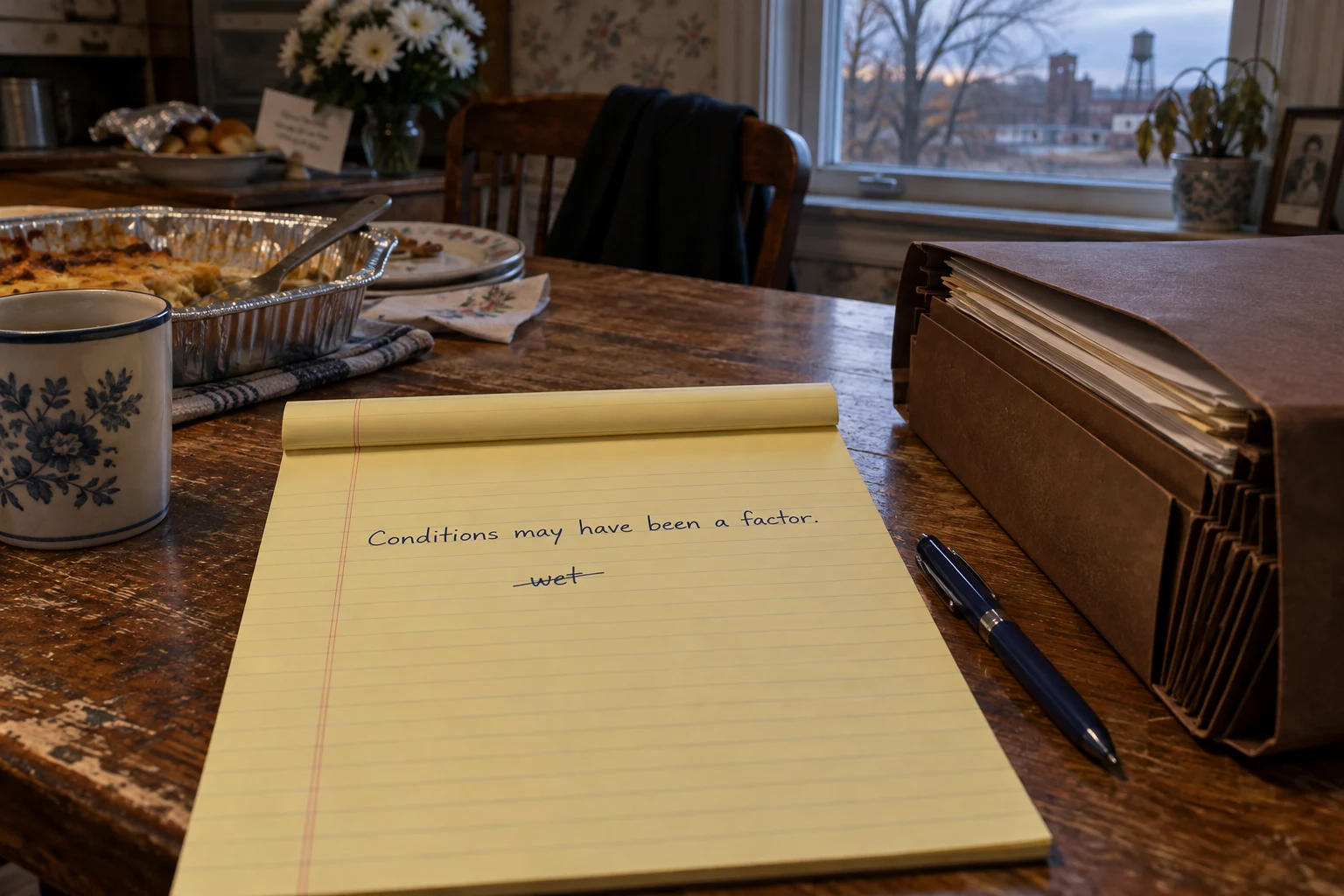
Then omission. “The road was wet.” Ray: “No. ‘Conditions.’” Lorna points out he wrote wet. “I crossed out wet. It’s ‘Conditions may have been a factor.’” It hasn’t rained in nine days. The new phrase no longer makes a specific claim about the weather. It preserves the suggestion while removing the detail Lorna can contradict. Then Lorna offers the fact that matters most — “He didn’t brake” — and Ray says, “Don’t say that.” Now the coach is deciding which true things she’s allowed to say.
Then the category. When the form asks for Dennis’s occupation, Ray writes “self-employed equipment consultant.” Lorna: “He fixed lawnmowers, Ray.” Ray: “He consulted on lawnmowers.” Here the edit stops being about how to tell the story and becomes a change to what the story is. It’s also where the audience begins to see that Ray’s interest in consistency isn’t only for Lorna’s sake.
Give the coach a creed. When Ray describes the man at the insurance company who “gets a bonus every time he doesn’t pay,” Lorna asks, “Is that true?” Ray answers, “It’s true enough.” That’s the editor’s whole philosophy in three words. Everything he coaches after that line, the audience hears through it.
Give the coach a student who can’t learn. The scene would be grim if Lorna were good at this. She’s terrible at it. She can’t hold a lie long enough to tell it. She learns the words fast and can’t make herself mean them. She repeats his phrases back in the wrong places, and every edit becomes audible. Later in the play, when Ray tries to soften the crash into “a terrible —,” she finishes the sentence for him with his own word: “Conditions.” An honest student turns coaching into comedy, because she shows the audience every seam the coach is trying to hide.
From here on, this entry discusses how the play ends. If you’d rather read or see Contestable first, now’s the time to stop.
Let the method outlive the content. What Ray really teaches isn’t any one answer. It’s a posture: don’t volunteer, say it in order, trust the sequence. “Say it in order and you can’t go wrong.” The content of the story collapses halfway through the play, but the method keeps going. Lorna turns it on him: when she hands over the evidence of his paperwork, she says she’s just “answering what she asks. In order.” And at the end, Ray applies the same coaching to a physical task, putting a rifle back in its case before the adjuster arrives. “Case first. Get it in the case, then check it all you want. One step at a time.” “In order,” she says. “In order. You can’t go wrong.” He has rearranged the steps of someone else’s procedure, exactly as he spent the afternoon rearranging her story, and this time, the consequences of his preferred order are immediate and physical.
Let the last edit be his own. When it’s over, Ray’s first words are “…That’s covered.” He reaches for his professional vocabulary before any human response. The sentence gives him a category for what has happened without requiring him to name his part in it. It’s the last edit of the afternoon, applied to himself.
When does helping someone explain become taking control of what they say? In Contestable, Ray crosses that line when he stops helping Lorna express what she knows and starts instructing her to leave out what he needs concealed. He still calls it preparation. The story is becoming his, told in her voice.