You tell the truth.
Or you don't.
Exit Interview has never felt that simple to me.
Alex has been invited to speak honestly. The institution promises that his answers matter. The form suggests this is an opportunity for reflection, improvement, even closure.
He has every reason to believe that.
He also knows something else.
Some answers become records.
Some records become conversations.
Some conversations become consequences.
So before almost every answer, Alex is solving a problem the interview never acknowledges.
How honest can I be...
...without becoming a problem?
The real question is whether the truth is survivable.
The play keeps showing us that calculation without announcing it.
Sometimes it's only two words in a stage direction:
Too quickly.
The answer arrives before Alex has finished deciding whether it's safe.
His body commits before his judgment does.
The interview moves on.
The audience doesn't.
Sometimes the calculation happens without a word.
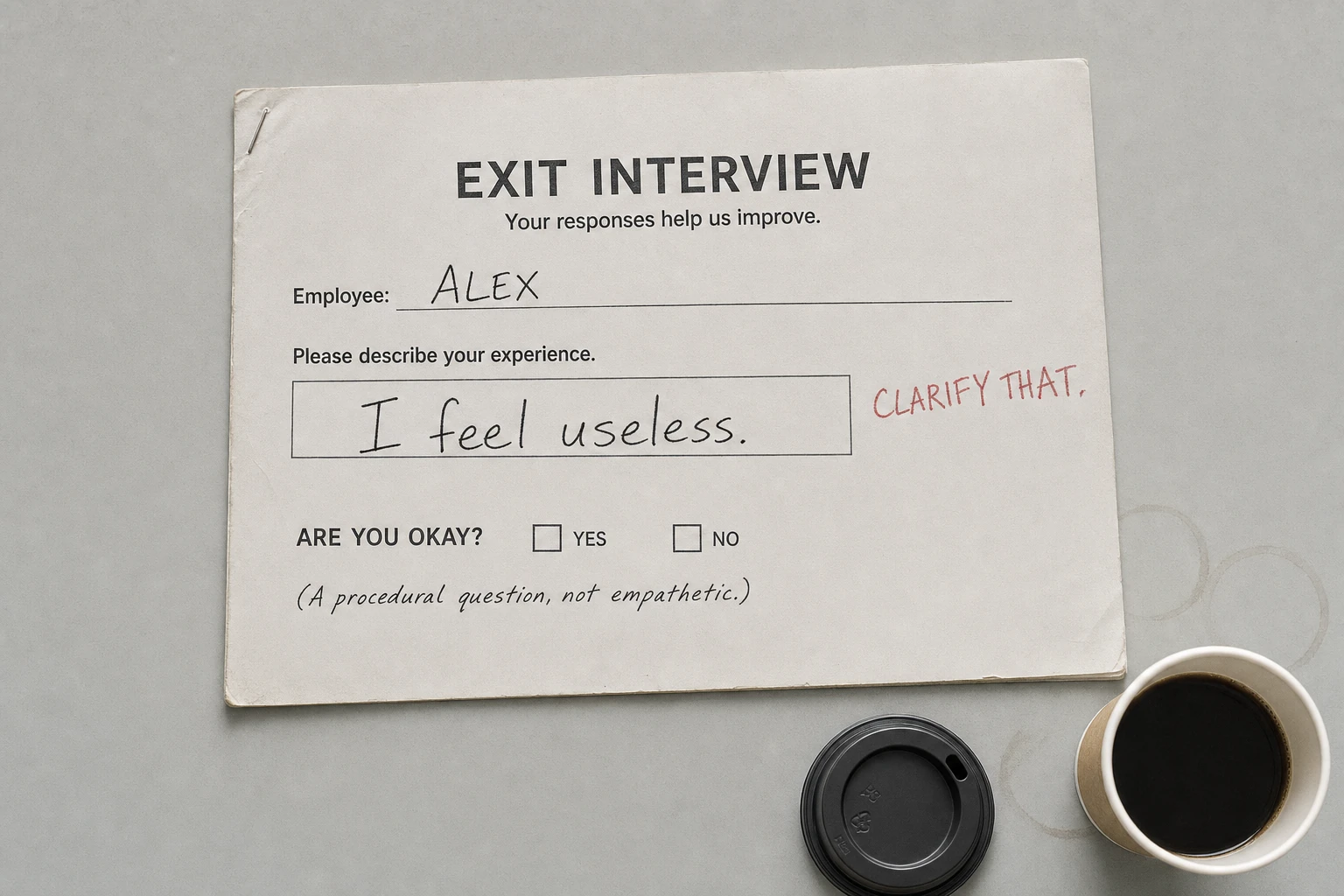
Alex adjusts the lid on his coffee cup.
Puts it back.
Takes the lid off.
Leaves the coffee untouched.
The cup becomes its own conversation.
He's trying to look like someone who isn't performing invisible arithmetic.
The audience watches him fail.
Then, finally, he says the truest sentence in the play.
"I feel useless."
The response comes immediately.
"Clarify that."
It's a perfect institutional answer.
Think about what that sentence cost him.
Every answer before it was hedged, weighed, made safe. This one wasn't.
He spent it.
And the interview asks him to itemize the purchase.
That's the tragedy.
Alex has the truth ready the whole time.
What takes him so long is the arithmetic.
I don't think that's unique to exit interviews.
Employees know it.
Students know it.
Patients know it.
Children know it.
Spouses know it.
Anyone who has ever answered,
"I'm fine."
while quietly negotiating the consequences of a more truthful answer knows it.
We often imagine honesty as courage.
Sometimes it is.
More often it's negotiation.
Every difficult answer is trying to accomplish two incompatible things at once.
To describe reality accurately.
And to preserve a future you still have to live inside.
Institutions supply the pressure; the play's real argument lives in the people forced to calculate within them.
People performing silent calculations before ordinary sentences.
People editing themselves because they still have to come back tomorrow.
The interview ends with one final question.
"Are you okay?"
The stage direction quietly answers for us.
(A procedural question, not empathetic.)
I love that distinction.
The question may be sincere. Alex needs recognition rather than reassurance.
Perhaps that's what the play has been saying all along.
The hardest part of honesty is rarely knowing what's true.
It's trying to tell the truth...
without becoming a problem.