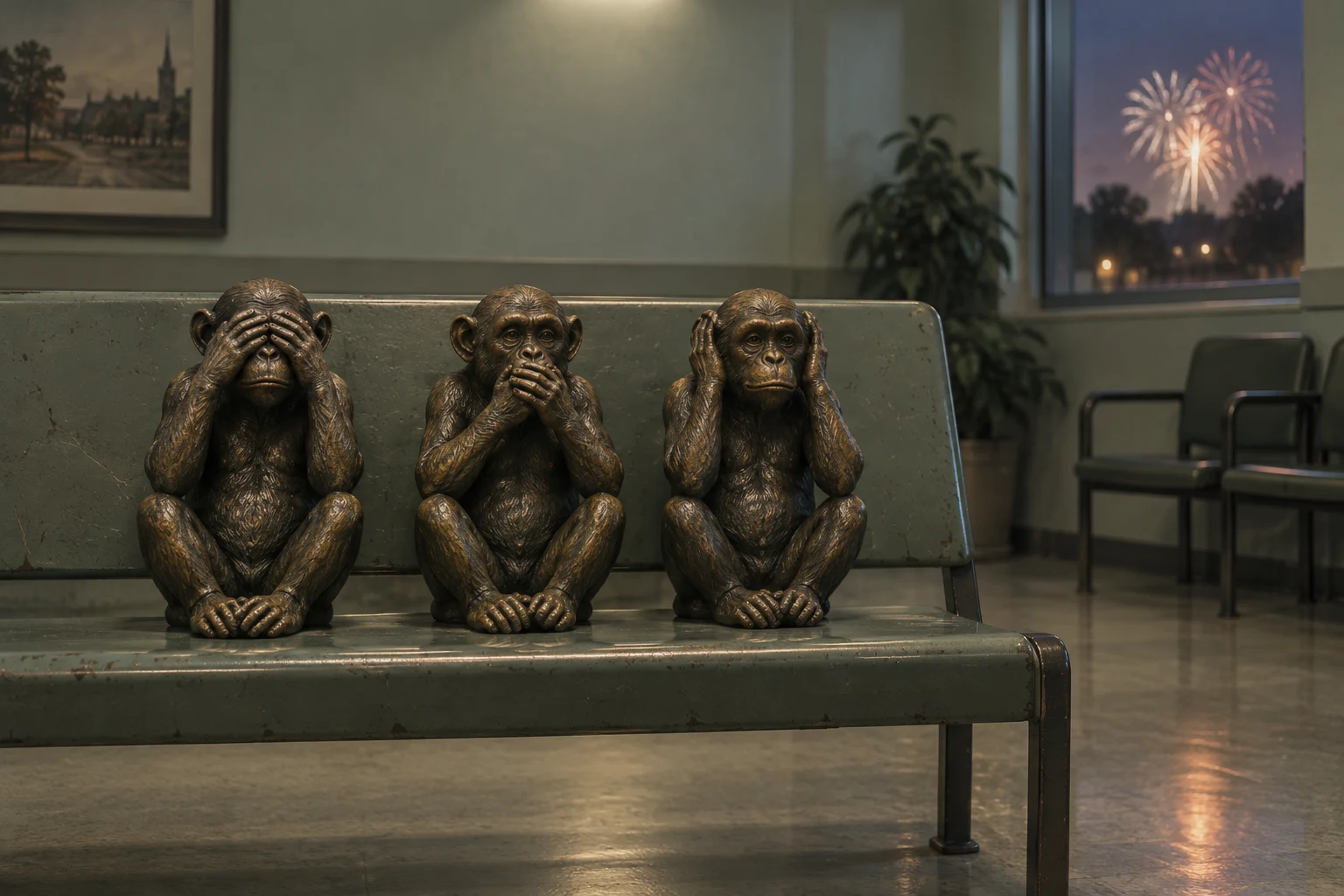
The stage loves a verb. Somebody picks up the gun, opens the letter, walks out the door, and the audience leans in. Inaction is harder to stage. A character who appears to do nothing can read as furniture.
That was the problem with Blind Eye. The thing Bodie and Lena are responsible for happened hours before the lights come up, and what they did was watch without intervening. Lena saw a woman hand a bottle to a man with a hundred and eighty-some days of sobriety, and she stood there “with a paper plate of nothing” in her hand. If the play was going to hold her accountable, it had to make watching count as a deed. These are the tools that did the work.
Precise noticing. Responsibility starts with what a character admits she saw, and the more exactly she saw it, the less room she has to claim she didn’t know. Lena doesn’t say she had a bad feeling. She says, “She held it out and said something and he took it.” She remembers the car, the intersection, the exact words from the front seat: “If you had any balls you’d go through that light.” Every precise detail is evidence against her. A vague witness can plead ignorance. A precise one has already testified.
Trained noticing. Lena is a nurse. Partway through the play she describes her work: “Somebody comes in, and I already know before they say a word — how they’re standing, how they won’t look at the person who drove them. I know the shape of it. I just... catalog it. Stabilize it. Send it home.” Seeing what other people miss is her profession. That raises the price of every glance she turns away. A bystander can claim she didn’t recognize what was in front of her. A woman who recognizes that shape for a living has no such defense, and she knows it: “I saw it coming with her tonight, an hour before it happened, and I looked away on purpose.” Bodie tries to wall the two worlds off: “That’s not the same as this.” She won’t let him. Her anger at herself is the anger of the person in the room best equipped to have done something.
Ordinary evasions. Bodie never says anything outrageous. He says “We don’t know exactly what—” and “People say things” and “There’s always a—” and “What were you going to do, tackle him?” These are the small, reasonable sentences people use every day to get out of the way of something. I let Lena cut most of them off, because the habit matters more than any one argument. Then I gave Bodie a real defense. When Lena accuses him of making it make sense “so it’s smaller,” he answers, “Or so it’s survivable.” An evasion with no reason behind it is just a weakness. An evasion that protects something the character needs is a choice, and choices are dramatic.
Silence with a known alternative. A pause only means something when the audience knows what could have been said in it. After Lena demands an apology instead of a lecture, the stage direction reads: Silence. Bodie looks away first. That’s the title of the play performed in four words. It works because we’ve just heard exactly what he could say. The silence is a refusal, and the audience can see what’s being refused.
Interrupted recollection. Twice Lena starts the same sentence: “Sometimes I wonder if that’s what I did with—” Twice she stops. Bodie asks; she says, “Nothing. Forget it.” The second time, the direction says she won’t finish it, not tonight. Whatever that sentence is about, the audience watches her choose not to look at it, in real time, in front of them. That’s the play’s subject happening on stage, live. The temptation is to finish the sentence somewhere — a late confession, a name. That would turn an action back into information. Left unfinished, it stays something she’s doing.
The gesture withheld. Patrick, the one who actually drank, says nothing at all. He takes out his sobriety coin, turns it once, starts to hold it out to Lena, and closes his hand around it instead. Even the person whose action brought them into the waiting room ends the play by not doing something. Everyone in the room has a version of the same move.
What all of this has in common is that the audience has to be shown the alternative before the character declines it. Looking away only reads as an action when we know what the character could have looked at. So the work is mostly setup: give them something to notice, let them describe it exactly, give them the words they could say, and then let them say something else, or nothing. The audience will register the choice even when the characters insist they never made one.
Outside the window in Blind Eye, a town is setting off fireworks. Nobody in the waiting room looks up.