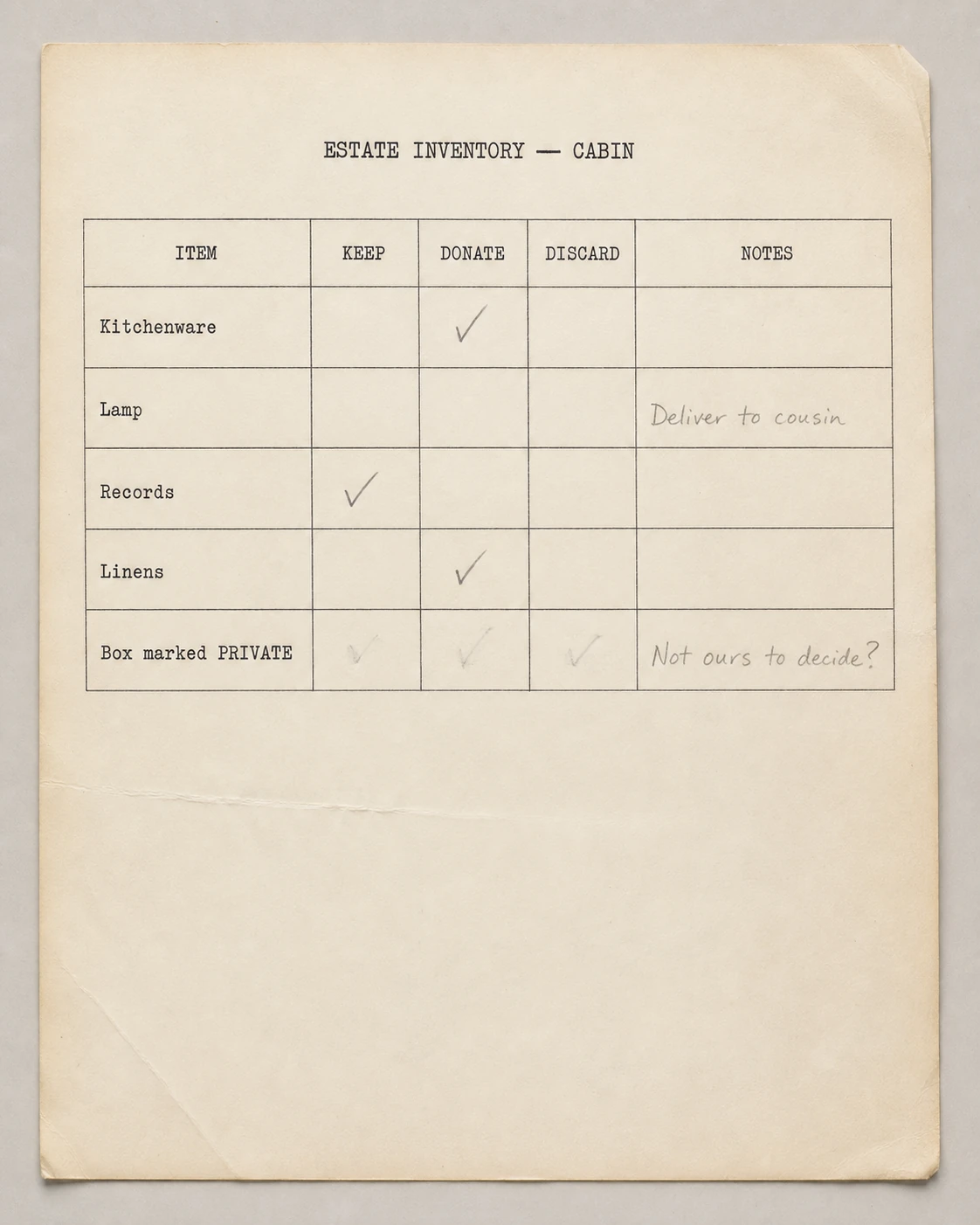
Every estate sale begins with a lie: that what's left behind can be organized.
Cataloguing is possible. So is sorting into categories of disposal: keep, donate, discard, deliver to the cousin who asked for the lamp. What can't be done is the other kind of organizing: making the accumulated material of a life cohere into something the living can understand, file away, and stop thinking about. That kind of order is a fiction the grieving tell themselves in order to begin. The box marked Private is where the fiction runs out.
Remains begins with a practical problem. Angela and Jim are gone. The cabin has to be cleared. There is a system — there's always a system, because systems are how people manage proximity to unbearable things — and the system involves categories, labels, and the negotiated logic of who gets what. The sorting looks administrative. For a while, it is — and the shift, when it comes, is gradual enough that the characters are inside it before they recognize where they are.
The sorting becomes a displacement activity for the real conversation. Keep. Donate. Discard. These are manageable categories. They have the appearance of progress. You can spend an entire afternoon moving through them and feel that you have accomplished something, and you have. But the box on the shelf remains untouched. Eventually the afternoon runs out, the box is still there, and the system has no category for it.
The valuable things have clear stories and destinations. The ordinary things resist filing. Their monetary value may be negligible; their meaning isn't. That meaning was private, and now it is accessible only through inference and the particular grief of realizing that you are guessing at your own parents.
The children are sorting through more than furniture and kitchenware. They are sorting through evidence: of who Angela and Jim were when their children weren't in the room, of a marriage and a private life, of choices and histories and versions of their parents they were never given access to. Angela and Jim left no authorized narrative, only objects. Their children must decide what story those objects tell, knowing that any story they construct will be partial and shaped by what they wanted their parents to be as much as by what their parents were.
The estate invites them in. It doesn't grant them permission.
Somewhere in one of Angela's boxes is a spreadsheet for managing a squirrel — trap types weighed against a column labeled "emotional impact on intruder." It's a joke in the play, and it lands as one. It's also the same instinct that produced the box marked Private: a mind that couldn't leave even a nuisance rodent unclassified by conscience. Angela didn't compartmentalize her ethics from her filing system. She built them into the same document.
"Private" is both a label and a dare.
Angela may have written Private for herself: a practical label, a boundary she expected to enforce while alive. Death changes the addressee. What began as a note to self becomes a message to survivors, and neither writer nor reader gets to renegotiate it. The word reaches the children at a moment neither party chose. It doesn't prevent opening. It makes opening a decision.
A locked box says you can't enter. A labeled box says you could enter, but consider what that means about you. The label transforms a physical object into an ethical problem. Opening doesn't resolve the problem; it deepens it, because now there is content, and the content has to be metabolized by people who didn't ask to know it and can't unknow it.
The box is also an archive of selection. Angela spent decades deciding what counted as private: what belonged inside, what remained outside, what disappeared altogether. Her children inherit the result, not the decisions that produced it.
What do the living owe the dead? I don't think the play answers that. It holds the question open long enough for the audience to feel its weight.
Objects survive where honest language doesn't. Families that couldn't talk about certain things while everyone was alive find themselves standing in a cabin holding evidence of those things, without the people who might have explained them and without the social permission structures that kept certain subjects off the table. The dishes still need to be divided. The knowledge has nowhere equally manageable to go.
What grief is allowed to know is a question nobody answers in advance. The living assume they will know what they need to know, and then someone dies and they discover that privacy is more durable than expected. The people they thought they knew were withholding in the way everyone withholds, because some of what we are belongs only to ourselves. We assume we will have time to decide what to do with it. Then we don't.
The box is what remains when time runs out.
I didn't want Remains to turn the box into a revelation that realigns everything. I wanted the moral problem to survive the opening, so that the content mattered less than the cost of learning it: what the act required the characters to decide about themselves, what they owed the dead, and what they were willing to know.
The box marked Private isn't the most dramatic object in the cabin. It might be the most honest one. It's the only thing in the room that told the truth about itself.