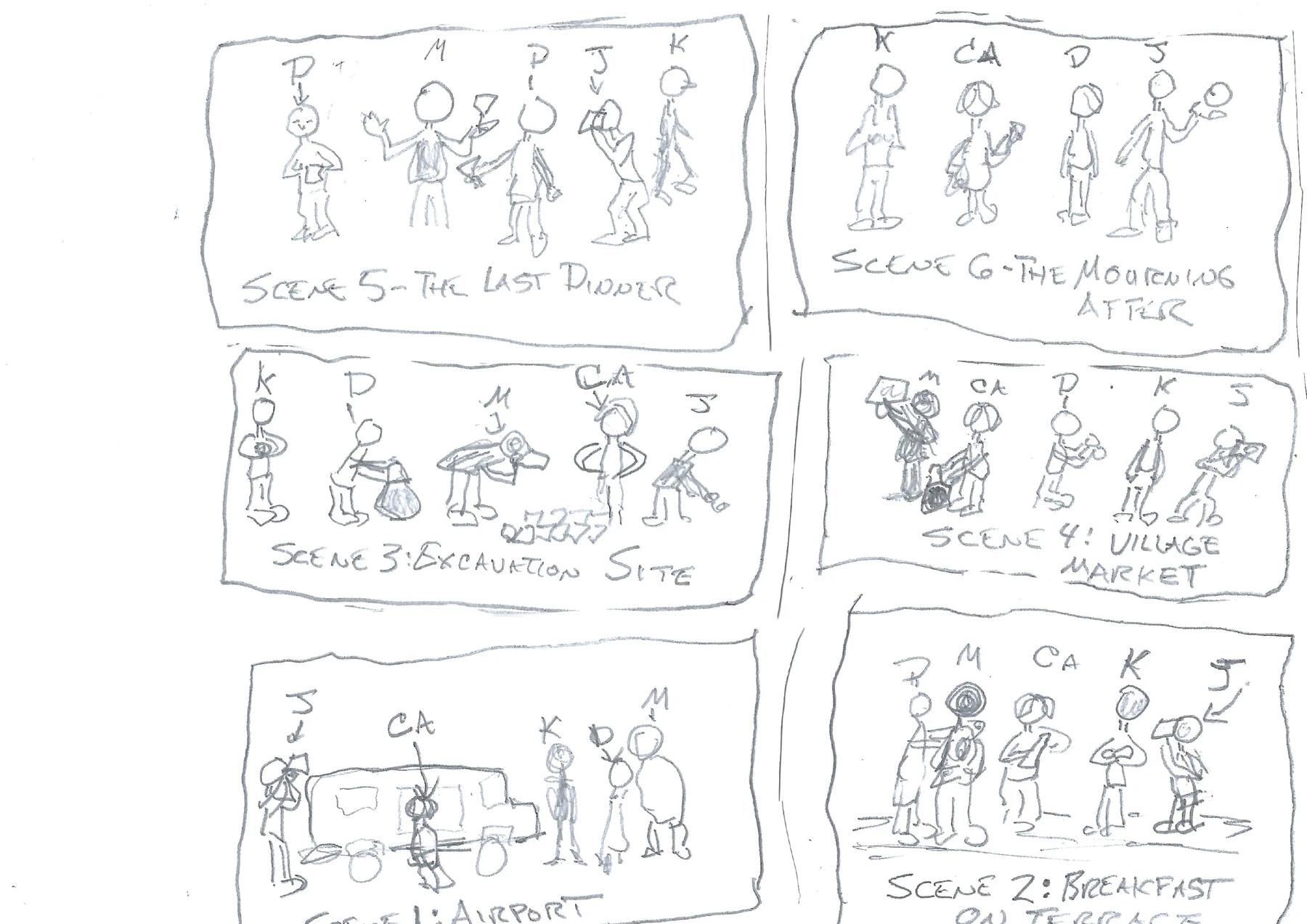
Dead Reckoning breaks that promise in the first ninety seconds. Jay looks at the audience and hands them the ending before anyone has done anything to deserve it.
“One of us is dead.”
That line is supposed to arrive in Act 3. Here it opens the show.
So what’s left to build toward, once the ending has already happened?
I don’t think the play is asking the audience to find out what happened. It’s asking them to find out what they already saw.
Scene 6 gives you the facts cold: Morton is dead, the phone is missing, everyone is composed in a way that doesn’t quite hold. Then the play walks backward through the three days that produced that room, and something strange happens to the material as it rewinds. Nothing new is technically revealed. You’re watching the same people do the same things you’d have watched them do if the story ran forward. The only thing that changes is what you’re allowed to notice while they’re doing it.
Kostas tells Jay, flatly, “I am a morning person.” First time through—Scene 6, the morning after—it’s a joke. Deadpan guide, over-caffeinated American, comic mismatch of temperament and tragedy. By the time you’ve rewound through the excavation site, the market, the walk in the dark that stopped at eleven forty-three, the same line has stopped being a joke about temperament and started being a fact about the previous twelve hours. He didn’t sleep. He was up making a phone call that went nowhere and then following a man he’d just told, to his face, “we are not” on the same team. The line hasn’t changed one word. Its category has.
That’s the whole engine of the piece, run over and over on smaller and smaller moments. Carol Ann rotating Jay’s phone ninety degrees so it lines up with the table edge reads as a tidy person being a tidy person—until you’ve watched her hand rest on the bag’s front pocket a beat too long at the excavation site, and now every fussy, controlling, faintly comic habit she has is evidence of the same person who could stand at a market stall and calmly buy “a traditional analgesic” and know exactly what she was buying it for. Diane covering for Morton—“he had a headache, went to bed early”—is a small kindness the first time you hear it. By the time you’ve rewound to the dinner where she watched him pocket a lie about Gretchen, it’s not a kindness anymore.
Nothing was hidden. It was only ungraded.
The difference between this structure and an ordinary mystery is bigger than the gimmick of running the scenes backward. A forward mystery hides the truth and dares you to find it. This one shows you the truth immediately and dares you to recognize it anyway, later, wearing the costume of something charming. The suspense isn’t what happened. It’s how long you’ll go on filing Carol Ann’s precision under “funny” before you’re forced to file it under “motive.”
Jay is the only character built to survive that whiplash on purpose. He’s the one holding the camera, which means he’s the one recording things before he understands them—the pill organizer, the phone call about coordinates and a buyer, the wine glass, the bag strap that hangs wrong and never gets fixed. He says it himself, holding evidence he filmed without knowing it was evidence: “I have some of it on here. I think.” It sounds like a joke about a distracted tourist. It’s the audience’s own position, handed to a character so we don’t have to feel alone in it. We also have some of it. We also didn’t know we had it.
That’s closer to how understanding actually arrives in a life. We rarely meet a person all at once. We collect them in small, ungraded pieces—a habit here, a joke there, a phone call we weren’t meant to overhear—and file each one under whatever category costs us the least. Understanding, when it comes, rarely hands you a new fact. More often it just makes you go back and re-read the ones you already had.
Which is why I don’t think of the reverse structure as a trick played on the audience. A trick withholds. This play doesn’t withhold the outcome—it tells you the body count before the curtain speech is finished. What it does instead is force you to carry a piece of knowledge you can’t yet use, all the way back through everyone’s most ordinary, best-lit behavior, and watch what that knowledge does to ordinary behavior once it’s finally allowed to touch it.
The play never quite resolves what the fragment in Jay’s pocket actually is, either—not in the way a normal object gets resolved. He carries a wrapped package for two acts, certain it’s a rock, and it is a rock; it’s also twelve centuries old and the reason a man is dead, and both of those things are true about the exact same object at the exact same time, and the play doesn’t ask you to pick one. “Andreas was a good name for it,” Kostas tells him, at the end, and he means it. The name given in ignorance turns out not to have been wrong.
It was just early.