The sentence is satisfying because it makes understanding sound like a destination. The play was unclear; then the audience arrived at clarity. But the six scenes have stayed exactly where they were, every line landing in the same position. What moved was the audience. They walked backward through three days carrying a death they could not forget, and by the time they reached the beginning, they could no longer see anything as a person at the beginning would see it. The scenes did not become clearer. The people watching became different readers.
Every life is lived forward and explained backward. We make decisions inside uncertainty and justify them inside memory, where the explanations are usually cleaner than the experience ever was. We do not experience our lives as completed narratives. We experience them as Tuesday: incomplete information, conflicting obligations, partial memories, shifting loyalties, and whatever emotional weather the day brings. Meaning tends to arrive later, once consequences have given the past a shape it did not possess while we were living it.
Reverse chronology makes an audience inhabit that distance. Knowing where a person ends up turns earlier choices into evidence. Warning signs multiply. Motives acquire edges. Coincidences begin looking inevitable. The facts may support those explanations, but the confidence comes partly from order—from receiving the consequence first and then walking toward the choices that produced it.
Morton says as much at breakfast, while he is still alive and pleased with himself. Diane remarks that the taverna already feels like the kind of place people remember correctly, and Morton tells her that a place can become more real in memory than it ever was in life. Jay asks what that means. “It means memory is a form of editing.” By the time the audience hears him say it, they have already attended his wake. Morton thinks he is describing how travelers remember tavernas. He is describing what every person watching is doing to him.
Dinner theatre lets the play begin that edit before the scripted action starts. During the mingle, the audience meets Morton in pressed khaki. He shakes their hands, asks where they are from, and misquotes Herodotus with the confidence of a man who has done it many times. Thirty minutes later, Jay tells them Morton is dead: “You probably met him in the mingle. That was last night for us.” A small, genuine memory of meeting a stranger is revised into a memory of somebody’s final evening. The audience does not choose to revise it. The change arrives with the news, as it does after a phone call that divides a life into before and after.
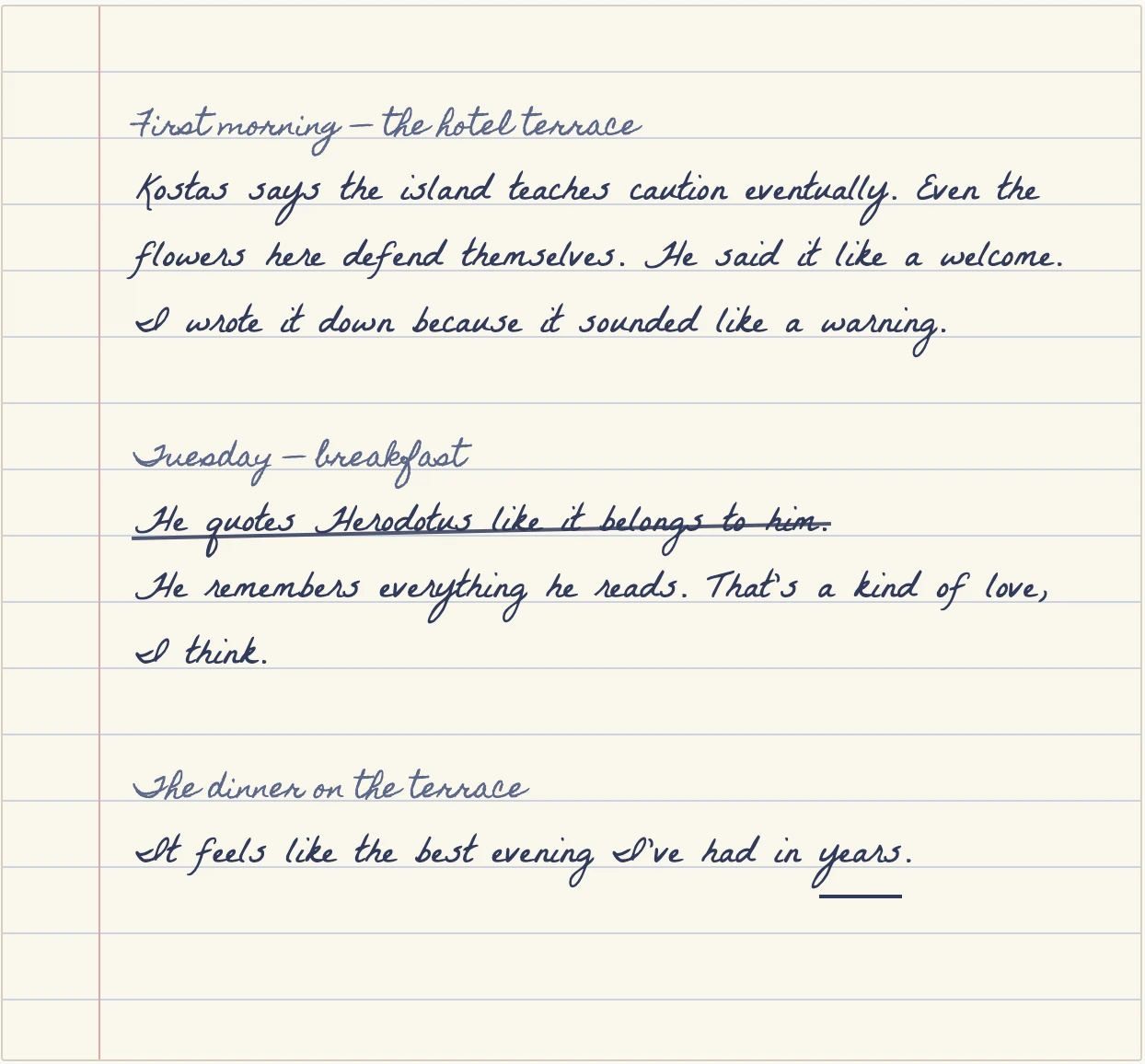
Diane’s journal records the same process from inside the story. On the last night of Morton’s life, she writes that it feels like the best evening she has had in years. The entry is honest when she writes it. Later, after everything that follows, she opens the journal and can no longer read those words as the woman who put them on the page.
Nothing in the sentence has changed; what has vanished is her access to the earlier version of herself.
Her line—“I knew something was wrong. I just chose the version where it wasn’t”—does not prove that she understood the danger at the time. It shows how completely later knowledge can occupy an earlier memory.
Hindsight also edits with more confidence than accuracy. At dinner, Diane steadies two tipping wine glasses and accidentally switches their places. The audience notices. Heads turn; somebody whispers. Moving backward from Morton’s death, they have found a sign and supplied it with a future. Except the poison traveled another route. In Act 3, Jay tells Diane the glasses did not really matter. “They mattered to me,” she says. That answer reaches beyond the mystery. After a divorce, a diagnosis, or a betrayal, we return to old moments looking for the point at which the ending became visible. Some of what we find truly was a warning. Some of it was a wine glass. Memory gives both the same stamp of certainty.
The audience’s laughter enters the record too. They laughed at Morton’s toast and at the Herodotus quotation getting shorter every time Jay counted it down. Those laughs belong to the evening as it was lived. By the end, the same memories carry embarrassment, grief, or the uneasy feeling that pleasure itself has become evidence. “I remember laughing” and “I can’t believe I laughed” describe one event held by two versions of the same person.
The damaged quotation makes the argument in miniature. Moving backward, the audience hears it recover words until Morton finally delivers it whole at the airport. The accurate version was sitting at the beginning all along. The play simply arranges for the audience to reach the beginning last, so accuracy lands as revelation and the earlier jokes reveal themselves as erosion.
Memory is not a neutral archive of what happened. It is one of the places where what happened continues to happen. Every new fact sends us back through choices, conversations, and ordinary objects we thought we had already understood. The past remains unavailable to revision, but our relationship to it does not. We keep changing the story because we keep changing the person who remembers it.
We live forward because we must. We explain backward because we cannot help it. The distance between those activities is where certainty is manufactured, regret takes shape, and most of us become who we are.