Spoiler note: This reflection discusses major revelations and the ending of Unredeemed.
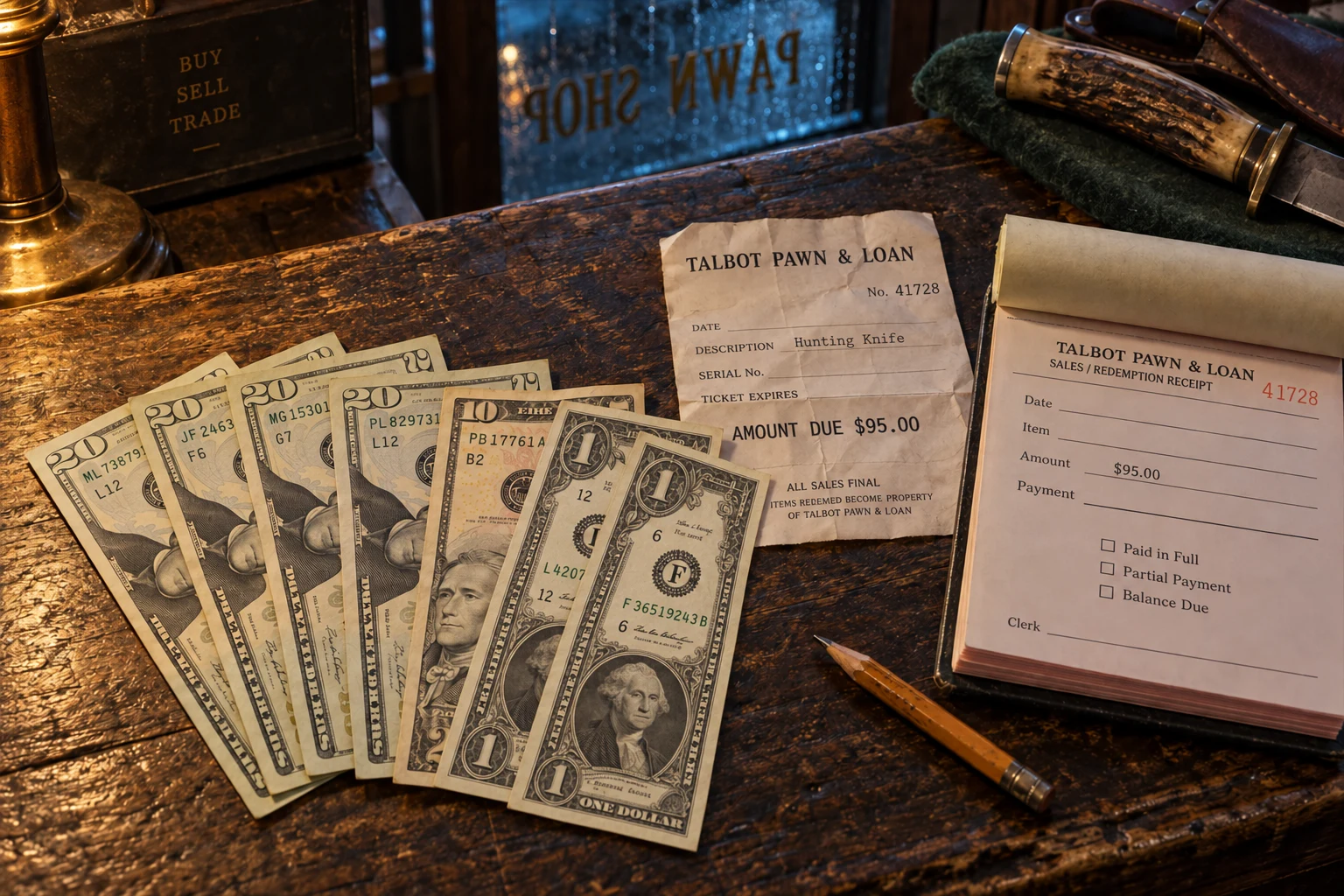
Deb Moss doesn’t walk into Talbot Pawn & Loan looking for a reckoning. She walks in with a pawn ticket and a calendar entry: “knife, ninety-two, after work.” She’s planning to be home in time to put her father-in-law’s hunting knife back in its case before her husband packs for camp. Then Duke tells her about the fifteen-dollar minimum service charge. It’s ninety-five. She has ninety-two.
The play is about a dead brother, twenty-two thousand missing dollars, a broken partnership and a man who may or may not have died alone on a mountain road. None of that is in Deb’s head when the lights come up. She needs three dollars by five o’clock. The play depends on keeping that practical need alive as she discovers what else is at stake.
Make the problem exact. Small problems only work on stage if they’re precise. “Eighty at fifteen percent a month, that’s twelve. Ninety-two.” Then the minimum charge. Deb counts the bills, stops, counts them again, spreads them across the counter so he can see. Later she rearranges them “as if a different order might produce a different total.” Arithmetic is action. The audience can see the shortfall, and they can feel how absurdly small it is. Three dollars is small enough to seem ridiculous and large enough to stop her. That combination lets the audience laugh and worry at the same time.
Let every attempt to solve it dig deeper. The deeper conflict never announces itself. It arrives because Deb keeps trying to fix the small problem. To get three dollars, she has to make a phone call, and the only person she calls is Ray, who used to be Duke’s partner and hasn’t set foot in the shop in years. To explain why she needs the money, she describes the knife, the antler stamped twice on the handle “like whoever did it sneezed,” and that detail is exactly what Duke recognizes. When Ray arrives and pulls out a checkbook, Duke says, “Cash only. Always was.” A rule that sounded like shop policy turns out to be aimed at one man. The ATM sends someone out into the rain. Every step toward three dollars lowers everybody further into the past. Deb is never investigating anything. She’s just running an errand, and the errand keeps opening doors.
Keep the small problem the same size while everything around it grows. As the stakes rise, the three dollars doesn’t. Ray says, “Duke. Come on. It’s three dollars,” and by then the line means something completely different from when Deb first said it. The distance between what she needs and what’s actually happening in the room is where the comedy lives, and later where the dread lives. The audience keeps measuring the size of the real conflict against the size of her problem, and nobody has to explain the difference.
Let the character’s habits do the excavating. Deb explains herself compulsively. Her husband says she “could confess to a crime I didn’t commit just from the momentum.” In another play that would just be a quirk. Here, the objective switches it on. She talks because she’s anxious about the money, and every story she tells to fill the silence hands Duke another piece of evidence. Frank’s saying about a knife not being yours until it’s drawn blood. The camp he “got for a song.” “Some family had to sell.” She doesn’t know what she’s revealing, and the audience realizes it before she does.
Solve the small problem too late. After the gate comes down at five, Ray goes through his wallet “for something to do with his hands” and finds a five, “behind the card.” Earlier, Deb had told him, “Sometimes there’s a dollar behind something.” Duke: “It’s five-oh-two.” Nobody touches the five. Then Duke uses the small fact as his verdict on all of it: “You were three short.” By then, the practical problem is no longer the only thing keeping her from the knife. It had to stay practical all the way to the end for that line to land.
End in the language of the transaction. The resolution comes in the terms the play started with. Deb puts all ninety-two dollars on the counter: “I know. It’s what I have.” Duke writes on the payment line that has been blank since the first scene and tears out the receipt. She reads it aloud: “On account.” A whole history of money owed, grief, and obligation passes through two words of bookkeeping. The receipt records a payment without declaring the account closed.
When a character arrives asking for the reckoning, the play has to deliver it, and the audience waits for it to arrive. When a character arrives needing three dollars, the reckoning can creep up on everyone, including her. Keep the errand small and real, give it a deadline, and let the bigger story come in through every attempt to finish it.