A note before reading: this entry discusses the endings of both Unredeemed and Contestable.
The easy way to pair two one-acts is by theme. These two certainly share some: money, a dead man, a family story nobody tells straight, a five o’clock deadline, a weapon in plain sight. Shared themes can make a coherent bill. Here, though, the connection goes further: the second play changes how we remember the first.
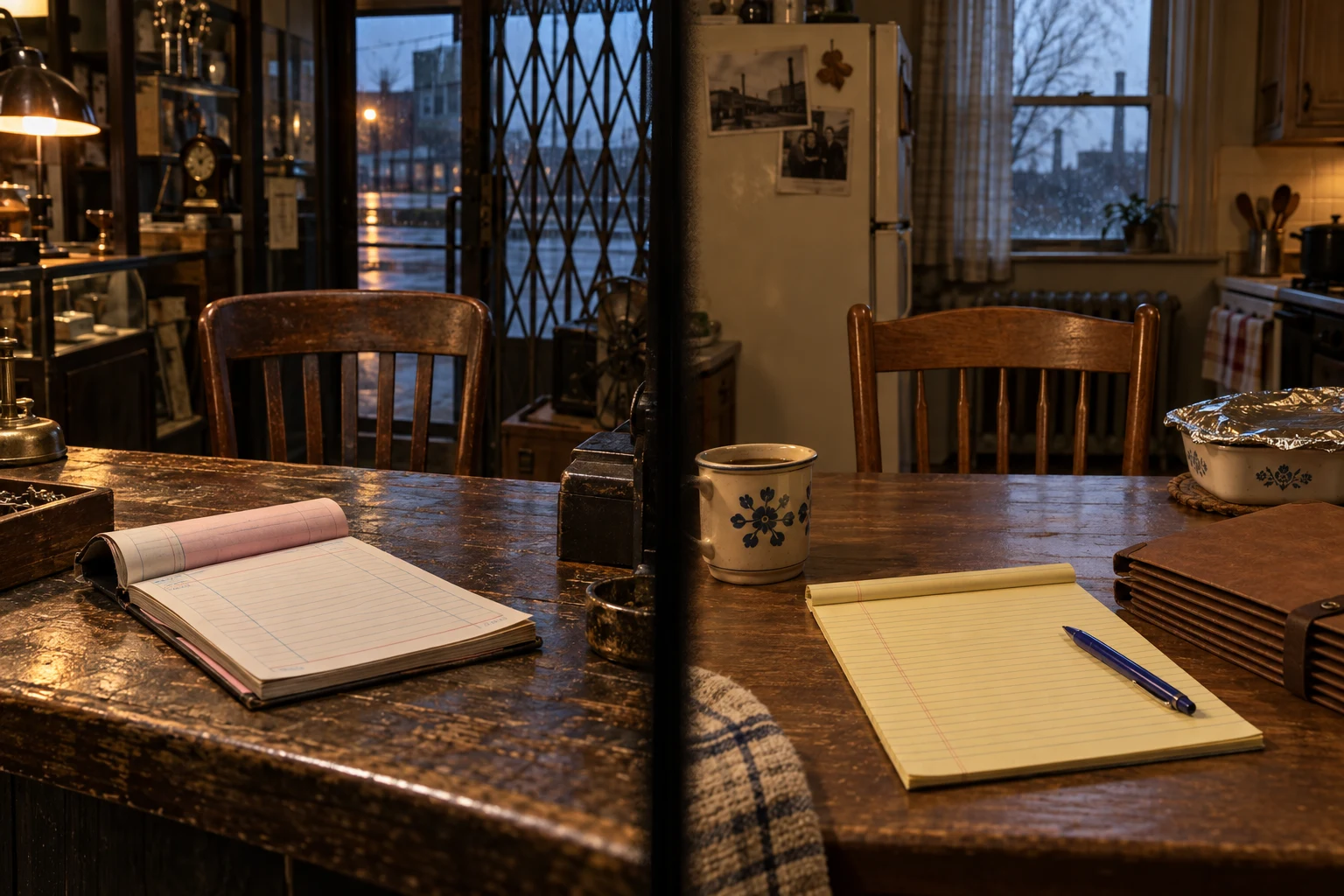
The first play ends at a beginning. Unredeemed closes with Deb ducking under the security gate with a receipt that says “On account.” Duke brings the gate down again, lays the knife beside the receipt book, opens it to a clean page, and says, “Sit down, Ray.” Ray sits. Blackout. Whatever happens between those two men, about Cody, about the twenty-two thousand dollars, about whether Ray left a dying man on a mountain road, happens after the lights go out. The play stops just as the real accounting is about to begin.
That’s the unfinished conversation in the title. Neither play tells us how it went. I imagine Contestable taking place some months later, in a different kitchen, letting the audience draw its own conclusions from the man in front of them.
The same actor carries the history. Ray appears in both plays, and he has to be played by the same actor. The audience recognizes him the moment he walks into the Pruitt kitchen with his legal pad. They remember the checkbook nobody would take, the phone greeting he couldn’t stop saying, Duke’s line: “You always answered so easy.” Then they watch him coach a widow through her statement, every answer smooth and ready. They can measure his polished answers against the conversation they last saw him being forced to have. The intermission is the gap of months. The actor’s body is the evidence.
The first play trains the audience. The second uses the training. Unredeemed teaches an audience how this world works. A weapon on the counter is a threat that ends in a gesture: Duke draws the blade across his own palm, and the danger turns into something like grace. A woman who can’t stop telling the truth is in danger because of it, and then saved by it. Deb tells Duke what Frank did on the mountain, “I can’t explain that. I’m not going to try,” and the gate goes up.
Contestable sets up every one of those expectations again. There’s a rifle on the kitchen table. There’s a woman who cannot hold a lie, and her honesty puts her in danger. Then her honesty saves a man: Lorna gets Wade to listen to his brother’s voicemail, and he sets the rifle down. The first play has given them a reason to hope that this danger, too, can be defused. Then the rifle goes off anyway, by accident, at two minutes to five.
The second play reveals how contingent the first play’s mercy was. After Contestable, Deb’s survival reads differently. Duke had a reason to let her go: he learned that somebody stayed with his brother. Lorna gives Wade a reason too. It works, but it cannot protect her from what happens next. Watching the second play, the audience realizes how much of the first play’s ending depended on one man’s history and one man’s choice. Deb doesn’t stop being saved. Her safety just starts to look precious and contingent, where after the first play alone it looked assured.
Why the order matters. Run the evening the other way, Contestable first, and everything changes. The audience would carry Lorna’s death into the pawn shop and watch Deb’s whole play as danger narrowly avoided. Unredeemed would become the answer to Contestable, and the evening would end on mercy, with a gate going up and a woman walking home. That’s a consoling shape, and some evenings should have it.
This one shouldn’t. Played in order, the evening begins with a world where honesty can still buy your way out and ends in one where it can’t, where the last word belongs to the man who learned the least: “…That’s covered.” Then the doorbell rings. Another account of what happened is about to begin.
What a pairing should do. Two plays on one bill should do more than echo each other. Each should know something the other doesn’t. Unredeemed knows what Ray’s charm costs when it fails. Contestable knows what it costs when it works. Neither play alone says that. The evening does, in the space between them, which is where the conversation stays unfinished.