Nobody in Café Rescue wants to answer that directly. Carby says he wants to save the restaurant. Ricky wants to improve it. Barb wants to honor it. The consultant wants to elevate it, and the critic wants to evaluate it. They are speaking about the same place and using compatible words. They are not describing the same future.
A beloved place stores more than memory. It distributes authority. The person who built it can point to the menu, the furniture, or the way the regulars are greeted and say: this is what my judgment made. The person who inherited it may experience those same choices as obligations made by someone else. The place holds both accounts at once.
That is why Carby is not simply defending a menu. He is defending the legitimacy of the choices that produced it. Change the food and the new menu may suggest that the original one was provisional—good enough for its time, perhaps, but ready to be corrected by people who arrived later with different tastes and a consultant’s vocabulary. What threatens Carby is not only change. It is the possibility of becoming a feature of the restaurant rather than its author.
Ricky faces the inverse problem. Keeping the restaurant exactly as it is may preserve Carby’s authority while making Ricky responsible for sustaining decisions he did not make and can no longer afford. His version of rescue requires change because continuity has become a form of debt. Carby hears betrayal where Ricky hears permission to survive.
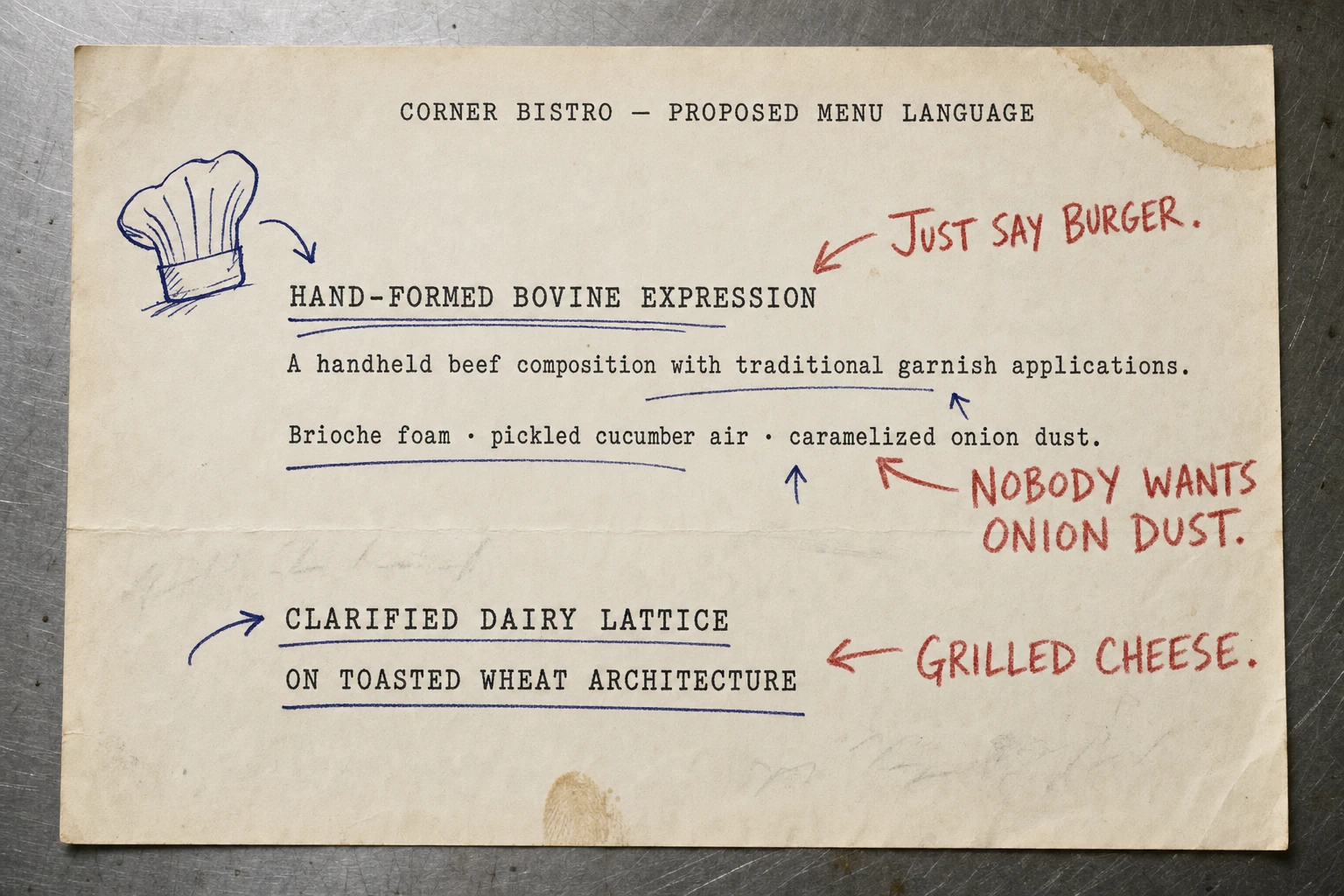
The consultant is funny and dangerous because his language is not fraudulent. “Brand identity,” “concept clarity,” and “elevated comfort food” have worked in other restaurants. They answer questions about competition, legibility, and market position. They cannot hear the argument taking place inside Carby’s family, where changing a sauce recipe may feel less like product development than a judgment on the people who valued it.
“Elevated comfort food” is a positioning strategy. From inside the family argument, it can also sound like a verdict: what you made was not enough; let me show you how to make it acceptable to people who were not here for it. The consultant means to enlarge the restaurant’s audience. Carby hears him dismissing the audience that gave the place its meaning.
Each character therefore uses “save” to claim a different authority. Carby claims the authority of origin. Ricky claims the authority of present responsibility. The consultant claims expertise. The critic claims judgment from outside, while Barb has spent years translating among everyone else’s claims and absorbing the cost of their incompatibility. They agree on the verb because agreement about the verb postpones the fight over who gets to define it.
That postponement is where the comedy lives. Everyone can sound cooperative while pursuing a future somebody else would experience as destruction. A plan to preserve the restaurant may preserve its objects and exhaust the people maintaining them. A plan to reinvent it may secure the business and evict the history that made anyone care whether it survived.
Neither danger is imaginary. Preservation can become an insistence that the next generation keep performing somebody else’s identity. Reinvention can become a transfer of ownership disguised as improvement. The play works because no single definition of rescue can absorb every legitimate claim on the place.
The question extends beyond restaurants. Families, theatres, neighborhoods, and institutions eventually confront the distance between continuity and survival. Staying recognizable may prevent necessary change. Changing enough to endure may leave people wondering what, exactly, endured. The argument becomes most intense when everyone believes they are protecting the same inheritance.
By the end of Café Rescue, the restaurant may or may not have a viable future. What has disappeared is the fiction that everyone was fighting for the same thing. The question is no longer simply whether the place can be saved. It is who has the authority to decide what “saved” will mean—and who may no longer recognize the place when they are finished.