Life works this way long before theatre does. A former spouse can shape a conversation without being mentioned. A parent’s judgment can survive for decades after the parent is gone. A friend who moved away, a child who stopped calling, or someone who died years ago may continue determining what can be said and what everyone agrees to avoid. Influence does not require presence. Sometimes presence is the only thing that could challenge it.
I once assumed I kept important characters offstage because mystery creates dramatic tension. That is part of the effect, but it is no longer the part that interests me most. When a person never enters, the play cannot settle who they are by placing a living body in front of us. It can only show what other people have remembered, needed, resented, protected, or invented about them.
Angela never appears in Remains. Amanda is gone before Callback begins. Whitfield and Voss never walk into the room in Firewall, while Jake exists only as a voice in Places. None of them needs a conventional entrance to bend the story. They are carried in habits, accusations, loyalties, unfinished arguments, and the care with which certain subjects are approached.
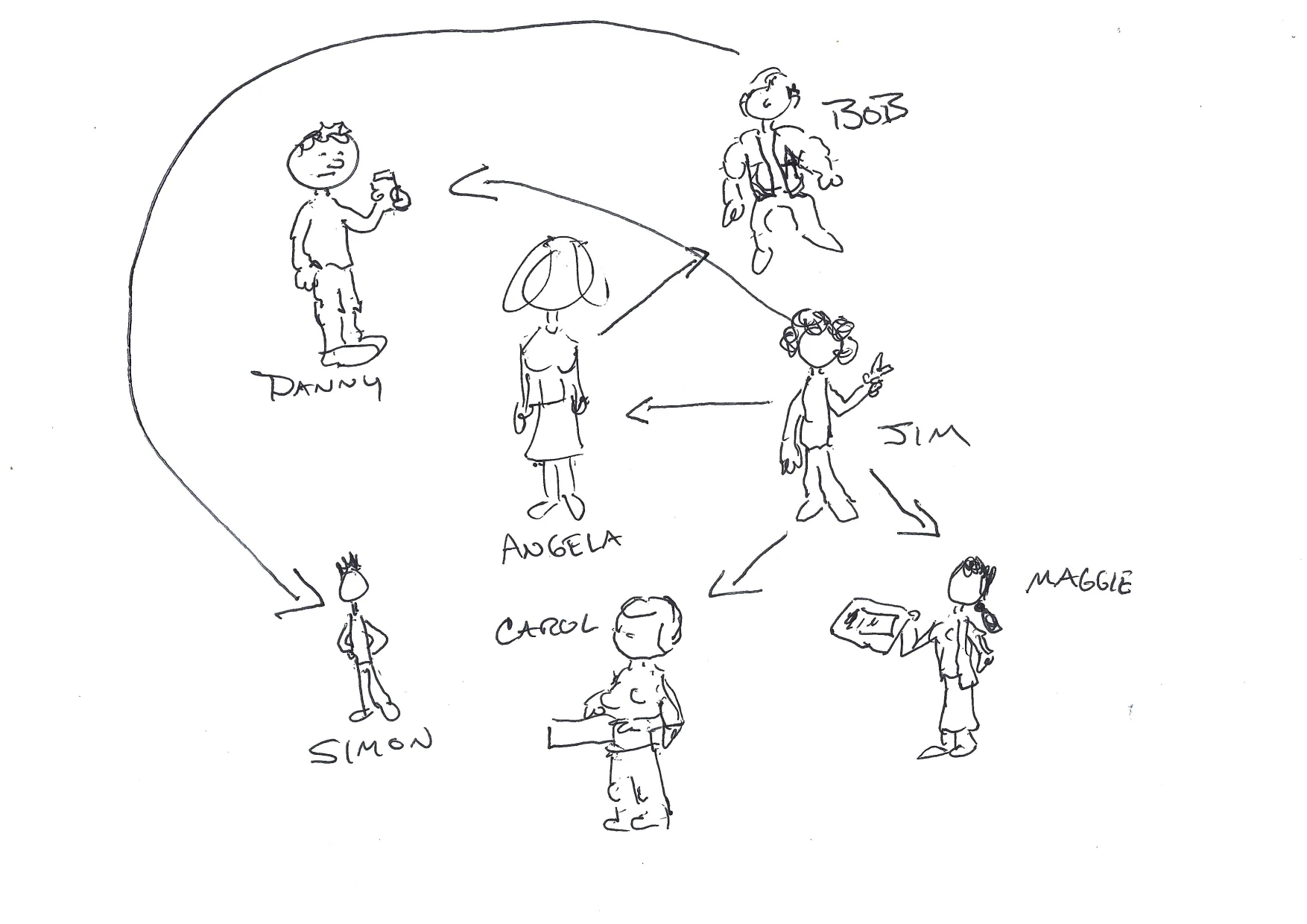
Angela makes the mechanism clearest. If she walked into Remains, the audience would meet a present-tense Angela: a woman able to answer a question, reject a description, or complicate somebody else’s memory. Instead, the audience encounters Maggie’s Angela, Simon’s Angela, and Jim’s Angela. The name remains the same, but each version belongs to a different relationship and has been shaped by a different combination of love, grievance, dependence, and loss.
Every conversation becomes testimony.
That testimony rarely produces an objective portrait. Maggie, Simon, and Jim reveal Angela, but they also reveal themselves through the act of remembering her. What each person notices tells us what mattered between them. What each person omits may expose shame, mercy, self-protection, or simply a memory worn smooth by repetition. Even agreement can be deceptive. Families often preserve one shared story because its familiarity is more useful than its accuracy.
The absent character occupies a peculiar position of powerlessness and influence. They may determine the emotional terms of every scene, yet they cannot interrupt. They cannot ask who authorized this version, supply the missing context, or object when an old mistake becomes the defining fact of their life. The person who bends the story has the least control over the story being told.
Memory is never shared equally; love and blame have their own uneven distributions. Two people can live through the same event and inherit different pasts because the event did different work in each of them. An absent character lets those incompatible histories remain visible at once. The audience assembles a person from fragments that overlap without fitting perfectly, much as we understand the important people in our own lives: through stories, impressions, objects, repeated phrases, and conversations that ended before we knew they were ending.
Keeping someone offstage does not preserve a puzzle with one correct solution. It preserves the limits of other people’s knowledge. A human being cannot be contained by any single description, including an affectionate one. Giving the absent person an entrance would not make them objective, but it would give them a present-tense self capable of pushing back. Without that entrance, everyone else must live with the versions they have made.
That creates a useful kind of dramatic pressure. Each new recollection can revise the portrait without completing it. An accusation may sound persuasive until we understand what the speaker needed from the accused. A loving memory may turn out to be a defense against anger. The audience keeps learning about the missing person, but the deeper movement belongs to the witnesses: every attempt to explain the absence changes our understanding of the people doing the explaining.
The most important character never walks onstage. They do not have to. Everyone else has already brought them in.