Every Post-it wall is an act of optimism.
It assumes tomorrow will cooperate.
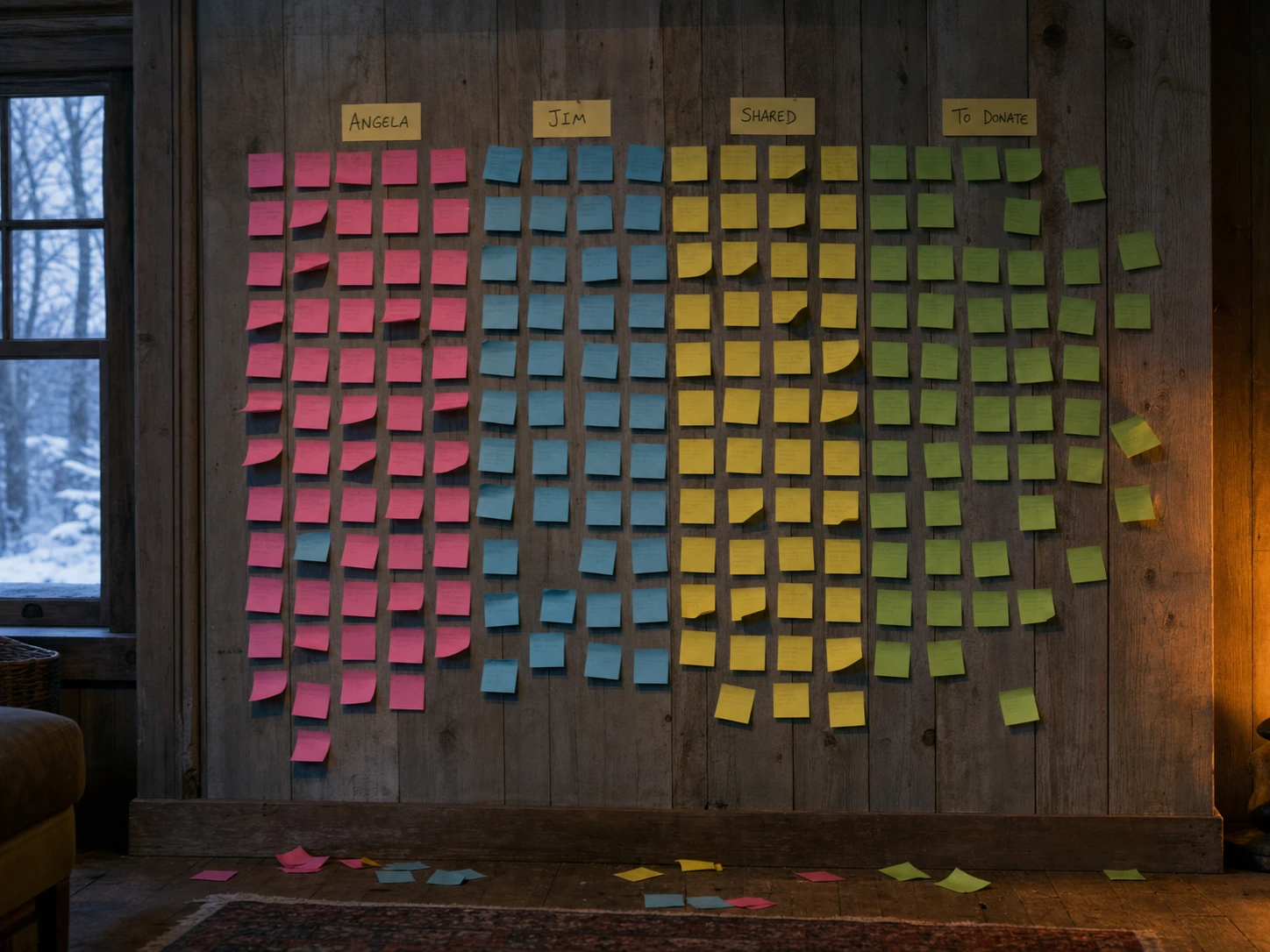
In Remains, Maggie builds hers because she believes a cabin full of her parents' belongings can be made manageable. At the start of Scene 2, she has turned the upstage wall into a command center: a precise grid of color-coded notes on weathered wooden paneling.
Pink for Angela's things. Blue for Jim's. Yellow for what they shared. Green for what can be donated.
The colors are bright, almost aggressively organized against the cabin's muted browns and grays.
She adjusts one note with deliberate precision and says, "It helps." Simon answers, "Worked great. Until it didn't."
It converts grief into administration. Objects can be named, assigned, moved, and removed. The family can argue about a lamp or a box instead of asking who Angela and Jim were when their children weren't watching. The grid gives the appearance of progress while protecting everyone from the conversation underneath it.
But the objects do not stay inside the meanings Maggie assigns them. Carol hands Maggie a stack of artifacts and accepts the answer "Blue" without questioning the category. Later, a photograph and a card surface together, and Maggie insists that they do not know enough to draw conclusions from either. The categories remain legible while the family becomes harder to sort.
Then Carol's casserole slips. Creamed broccoli and breadcrumbs spread across the floor, splattering boxes, the hem of Maggie's pants, and a few of the notes. One Post-it loses its hold, drifts down, and lands sticky-side-down in the mess.
The moment is funny. It is also the wall's first honest revision.
As the play continues, the notes curl at the edges, lose adhesion, and fall. Passing bodies disturb them. By the final scenes, the bright grid has been reduced to a handful of crooked squares. The room stops cooperating with Maggie's system.
The wall is Maggie's sorting system made visible — her belief that enough categories can keep grief from becoming disorder.
The sorting still has to happen. The cabin must be cleared, the dishes divided, and the boxes carried somewhere. The wall gets the family into that work. Inside it, each practical decision acquires a meaning beyond its square.
The wall begins as procedure and gradually becomes biography. Its deterioration measures the distance between the family Maggie expected to manage and the family the evening reveals.
Near the end, another note releases from the wall and lands at Maggie's feet. This time she does not restore the grid. She folds the note once and places it gently into a box of cards.
A note that once classified an object has itself become an object worth keeping. Maggie has stopped asking the wall to control the room.
The Post-it wall has to fail.
If it doesn't, the family completes an inventory but never confronts what the inventory cannot contain.