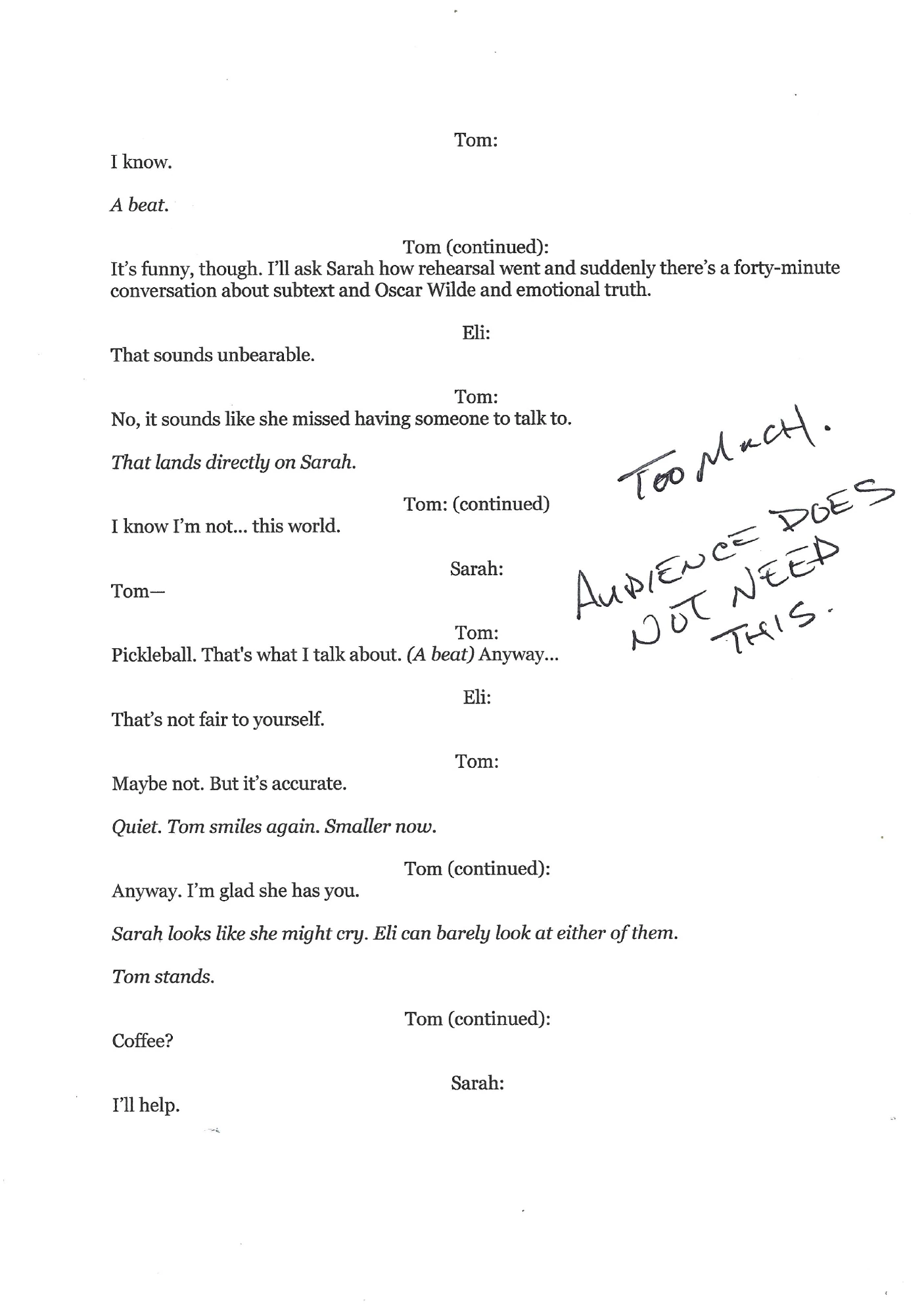
That’s not a metaphor. It’s a structural claim about how theatre actually works.
A play is not a delivery system for information. A screenplay can direct the spectator’s view with a close-up or a cut. A novel can wander into a character’s thoughts whenever it chooses. Theatre can also direct attention—through staging, light, sound, and proximity—but it cannot control the frame with the same precision. It unfolds in real time, in a room full of people who bring their own histories, unfinished conversations, private griefs, and hard-earned recognitions. You cannot control what they bring with them. You can only decide whether you’ve left them anything meaningful to bring.
I’m interested in plays that are precise about the right things and trust the audience to do the rest.
That balance is harder to achieve than it sounds. Every playwright feels the temptation to explain—to add one more speech, one more confession, one more scene that makes everything unmistakable. I’ve given in to that temptation often enough to recognize it. More importantly, I’ve learned to cut it.
While I was writing Places, the hardest cuts were the scenes that explained Sarah and Eli—drafts where feelings that had only been implied were finally spoken aloud. What those cuts left behind is a relationship the audience has to complete. What Sarah recognizes in that rehearsal room—or refuses to recognize—no longer belongs entirely to me. Someone who has stood across from a person they could no longer reach will recognize one story. Someone else will recognize another. Neither response is wrong. The play can hold both, but only if I don’t close the door too soon.
Marla taught me something about that.
She’s often described as the person who sees most clearly, and I think that’s true. But she isn’t there to explain the play. She creates pressure. She asks the question no one wants to answer. She refuses the comfortable explanation. She names things from an unexpected angle, forcing everyone else—including the audience—to look again. She doesn’t provide certainty. She makes avoidance more difficult.
That’s the work I increasingly want my characters to do: sharpen perception.
The rehearsal-room setting in Places does audience work I never had to write. In rehearsal, actors speak borrowed words before they can speak their own. They try on emotions at a safe remove. They discover themselves by pretending to be someone else. Audiences understand this instinctively. They watch for the moment when the borrowed words stop sounding borrowed. They sense the distance between performance and confession, between the role and the person playing it.
That distance is where some of the audience’s most important work happens.
I couldn’t write that into the script. It isn’t contained in the dialogue. It lives in the space between what is spoken and what everyone understands is being avoided.
After the staged reading at Towngate, I listened carefully to people’s reactions. I wanted to know where the play had actually landed. What fascinated me wasn’t that audiences responded differently. It was how differently. Some left thinking the play belonged to Sarah. Others were convinced it belonged to Eli. Still others found themselves most affected by relationships I hadn’t consciously imagined as the emotional center of the evening.
Instead of worrying me, that reassured me. It meant the play wasn’t asking everyone to find the same thing. It was asking everyone to finish the same structure in their own way.