Every creative rule closes one door.
The interesting question is which door you're willing to close.
Some rules exist to impress an audience.
Others exist to improve the writing.
Those are very different kinds of rules.
A gimmick changes the audience’s expectations.
A generative constraint changes the writer’s options.
One asks, Watch what I can do.
The other asks, What can I no longer get away with?
That difference matters more than the rule itself.
When people hear about Fine, they usually ask the same question.
“You wrote an entire play using one word?”
The tone tells me what they really mean.
Isn’t that just a stunt?
I understand the suspicion.
Most constraints are.
The idea announces itself before the writing has to do any work, and the writing spends the rest of the evening living off the announcement.
Fine only works because the rule never belonged to the audience.
It belonged to me.
The rule immediately took things away.
No exposition.
No names.
No speeches.
No convenient explanations.
No emotional escape hatch.
Language shrank to a single word.
Everything else had to find somewhere else to live.
Meaning moved into inflection.
Into timing.
Into silence.
Into the distance between the word and the feeling hiding underneath it.
The play became an exercise in relocation.
Nothing disappeared.
Everything simply had to find a new home.
Watch what happens as the word comes under pressure.
It begins as delight.
Two people are so happy to see one another that “Fine!” barely needs a definition.
A few moments later it becomes weather talk.
Then reassurance.
Then concealment.
Then the first outright lie.
Then heartbreak.
Then a joke about littering.
Finally, admiration.
The spelling never changes.
Every scene asks the same impossible question.
Can one word carry one more meaning?
The answer keeps surprising me.
Not because the word grows.
Because the pressure does.
The rule never tells the audience what to think.
It keeps asking the writing to discover another possibility.
That’s the difference between a gimmick and a generative constraint.
A gimmick repeats itself.
A generative constraint keeps discovering.
Looking back, I realize I’d been writing this way long before I knew it.
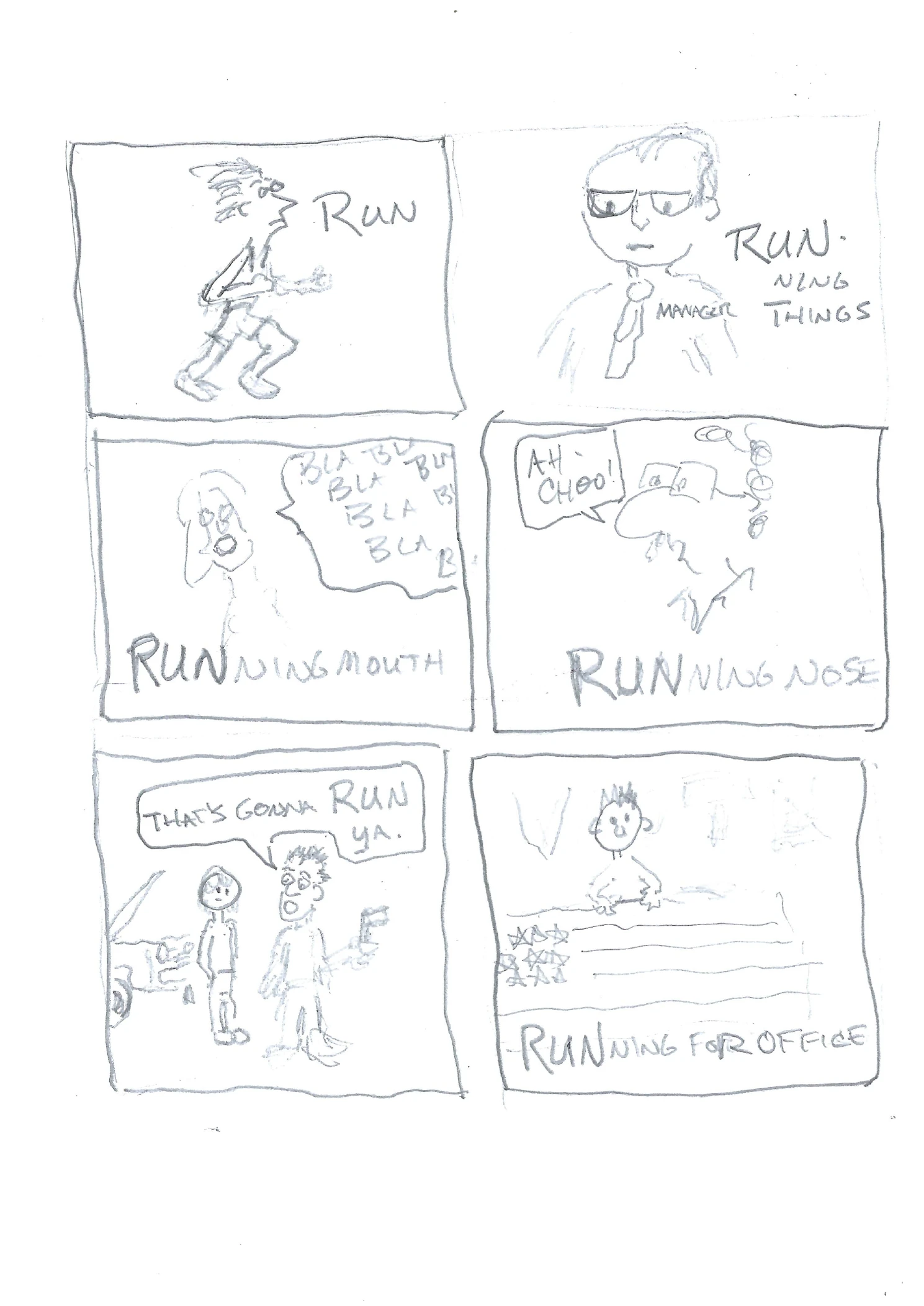
As a kid, I drew comic strips with a Flair pen.
Three panels across.
Five rows down.
No corrections.
If I made a mistake, it stayed.
The page had already decided what I wasn’t allowed to do.
I never thought of those limitations as creative.
I thought that was simply what paper looked like.
Only years later did I realize the page had been teaching me a habit that would follow me into playwriting.
Good forms remove possibilities.
Not because difficulty is automatically virtuous.
Because every removed possibility forces invention somewhere else.
The same instinct keeps appearing in my work.
A rehearsal room limits honesty.
A winter storm limits escape.
Reverse chronology limits certainty.
One word limits language.
Different plays.
The same question.
What happens after the easiest solution disappears?
That’s become the test I return to whenever a new rule presents itself looking like an idea.
Does this limitation force better writing?
Or merely different writing?
A gimmick survives by being noticed.
A generative constraint survives by being felt.
The audience doesn’t have to admire the rule.
They only have to leave believing they understood two people on a park bench who never explained themselves—and never needed to.
Fine was never about how few words I could use.
It was about how much one word could be asked to carry before another meaning appeared.
Every worthwhile constraint asks the same thing.
Not How unusual can I make this?
What easy solution am I finally willing to give up?