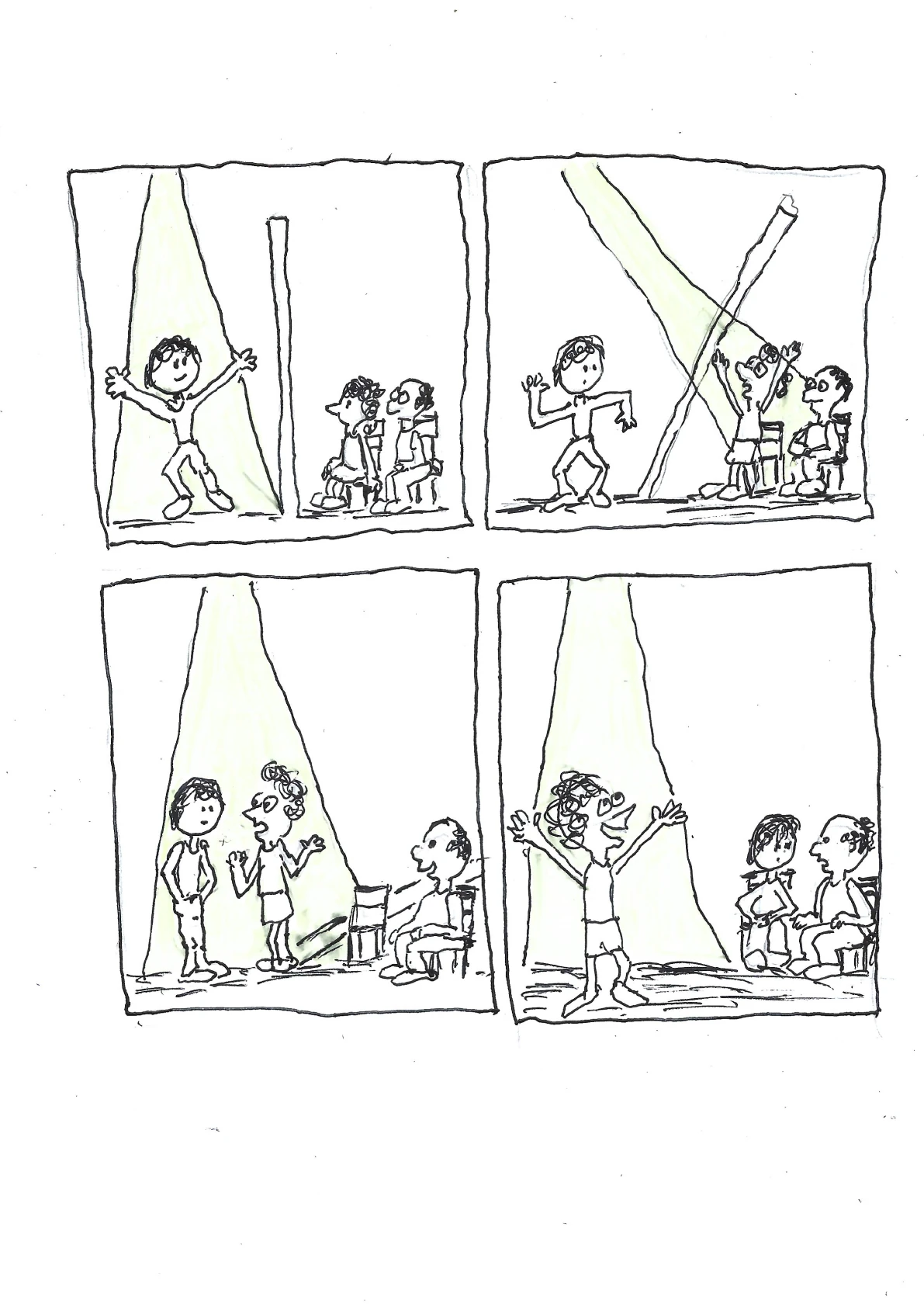
Every play begins with an invisible agreement.
The audience agrees to pretend they aren’t there.
The actors agree to pretend they can’t see them.
For two hours, several hundred strangers share the same room while everyone politely maintains the fiction that the people onstage are alone.
It’s a beautiful convention. It has produced most of the theatre I love. But it is still a convention.
Interactive theatre breaks exactly one illusion. The story remains invented. The murder is still fake. The detective still knows things no detective could know. What disappears is the pretense that the audience does not exist.
The moment a detective turns to the room and asks, “Who saw something?” the evening becomes unexpectedly truthful. Of course those people are here. They’ve been here all along. The play simply begins acknowledging them.
The audience was always part of the performance.
Interactive theatre admits it.
I’ve had thirty-one seasons to test that idea. Mystery Theatre Unlimited has put me in front of thousands of audience members across more than sixty original productions, and the experiment has never really changed.
When I hand a stranger a moment, it usually comes back better than I wrote it.
People understand rooms.
They know when a beat needs filling.
They know when it needs protecting.
They’ve spent their entire lives reading conversations they weren’t leading—family dinners, staff meetings, rehearsal halls, classrooms, church basements, waiting rooms.
When you invite them into a scene, they arrive already fluent.
That changes what a script is.
A conventional script is a recording.
Fixed.
Repeatable.
Complete before the house opens.
An interactive script is a score.
It establishes rhythm, dramatic purpose, safety, and direction.
The audience supplies the weather.
No two performances are identical. I used to think that was the cost of the form. I’ve come to believe it’s the definition of theatre.
In Good Grief, It’s Christmas!, the Wise Men are recruited from the audience, and the stage direction says they enter “with great enthusiasm and varying levels of commitment.” I wrote that direction knowing I could never know. The script anticipates uncertainty instead of pretending to eliminate it.
Later, another character turns to an actual adult in the audience and says, “We’re all adults now. You can just talk to us.”
There is a beat.
The answer is:
“Waa.”
That joke cannot exist in a conventional play. It requires a real person making a real decision in front of everyone else. The laugh arrives because the audience watches someone choose to stay inside the game.
In The Case of the Black Velvet Notebook, entire interrogations are built around questions that audience members invent on the spot. The actors aren’t pretending to discover those questions. They’re actually discovering them. Every performance becomes a conversation no rehearsal could have produced.
Then there’s Signfeld 2040, where I pushed the confession farther than I ever had before. The victim’s dying act is to hand an audience member a flash drive.
Every rigged bingo card.
Every black-market cheese transaction.
Every secret in the play.
“Guard it with your life,” he says.
Then he dies.
The audience laughs because everyone understands the convention. The important object has been entrusted to the safe person.
A full act later, while the suspects are busy accusing one another, the woman quietly raises her hand.
She drank the coffee.
The flash drive was in the cup.
It was dark.
She was thirsty.
Now the entire mystery exists inside someone who bought a ticket after work and expected a pleasant dinner.
Everything that follows belongs only to live theatre. The suspects debate stomach acid. Someone wonders whether a metal detector would help. Another apologizes because she came out for a nice evening and somehow became an accessory after the fact.
The audience is laughing because reality has refused to remain outside the play. If a character swallowed the evidence, it would be a clever plot device. When a woman at table six swallows the evidence, the room laughs at the truth of its own presence.
For the rest of the evening, the mystery’s entire record sits in the house, digesting. The play cannot honestly pretend she isn’t there. So it doesn’t. It hands her the microphone. It asks about her metabolism.
The joke isn’t that she swallowed the evidence.
The joke is that reality has acquired speaking lines.
In Good Grief, It’s Christmas!, the answer to the mystery spends the entire evening sitting among the audience. She arrives late. She smiles politely. Nobody onstage acknowledges her for a very long time.
The program quietly promises that the answer is somewhere in the room. Every night, that’s true twice. Once about her. And once about everyone sitting around her.
A conventional play asks the audience to suspend disbelief.
An interactive play asks the actors to suspend certainty.
Actors in an interactive play genuinely do not know what will happen next.
The surprise is real.
The recovery is real.
The improvisation is real.
The risk is real.
When an audience member says something no rehearsal could have anticipated—and someone always does—the actor has no prepared next four seconds.
Whatever happens inside those four seconds is theatre with the safety off.
I’ve written elsewhere about what audiences contribute to a play. This reflection is making a narrower claim.
Interactive theatre doesn’t add the audience to the play.
It stops omitting them from it.
Which is why this eventually stopped being an reflection about murder mystery dinner theatre. The mechanism changes from play to play.
Sometimes the audience is literally a Wise Man.
Sometimes they’re a detective with a card in their hand.
Sometimes they’re finishing a joke.
Sometimes they’re sitting quietly in the dark deciding what belongs in the box marked Private.
The philosophy doesn’t change.
For forty years, I’ve refused to write for a room I pretend is empty.