The laugh arrives a fraction of a second after the line.
That's how long understanding takes.
That delay is the whole art form.
The performer builds the circuit.
The audience completes it.
Without that completion, there is no comedy.
What you hear in that brief silence is several hundred people performing exactly the same act of discovery at exactly the same moment.
Why explaining kills the laugh
Everyone knows an explained joke dies.
Fewer people can say why.
Boredom is certainly part of the answer.
The larger problem is that explanation performs the audience's half of the work.
The missing connection has already been supplied.
The discovery has already happened.
Nothing remains for the audience to contribute.
The joke has nowhere to occur.
One of the quiet disciplines of comedy is deciding how much to leave unfinished.
Leave too much, and the audience becomes confused.
Leave too little, and the audience never gets the pleasure of arriving.
Every joke is an act of calibration.
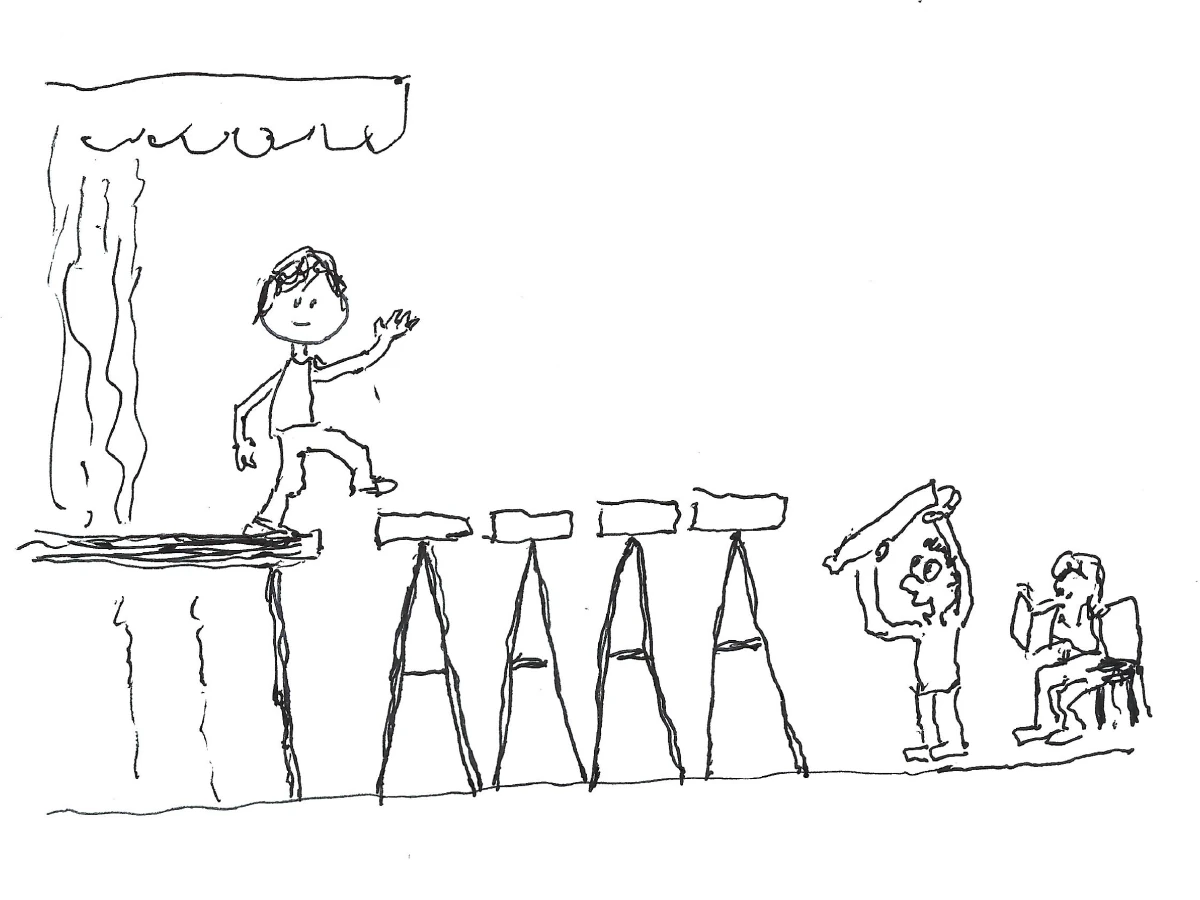
Every audience is being asked to cross a small bridge by itself.
The plays kept teaching me this
I didn't set out to write plays about trust.
I set out to write plays that worked.
It took years before I realized those were becoming the same project.
Every new script quietly removed another explanation.
Fine became the clearest example.
A woman sits on a park bench filling in the surnames of the Three Stooges.
Howard beneath Moe.
Howard beneath Curly.
Then she stops.
Larry.
An old flame appears, points to the empty space, and says the only word spoken in the entire play.
The script never explains why that word is the answer.
It waits.
Every audience arrives at "Larry Fine" on its own.
For one brief instant, the audience understands before the play says it aloud.
That moment belongs to them.
From there the single word begins changing meaning.
Sincere fine.
Dismissive fine.
Admiring-the-ring fine.
Spitting-at-the-ring fine.
The fine that objects to littering.
The fine that quietly says goodbye.
The audience writes the dictionary.
No definition ever appears.
It doesn't need to.
Comedy succeeds because the audience is permitted to complete the thought instead of merely receiving it.
Signfeld 2040 reaches the same destination from another direction.
Gorge Crustanza spends the play terrified of his Permanent Record Card, convinced an institutional file will someday explain his life better than the people who actually know him.
The audience recognizes the absurdity long before he does.
That difference in understanding is where the laughter begins.
I've written elsewhere about the Permanent Record Card itself.
Here I'm interested in the audience.
Gorge never discovers the comic logic imprisoning him.
The room does.
Comedy lives inside that unequal knowledge.
The character believes.
The audience understands.
The laugh is simply the sound that difference makes.
Interactive theatre made the lesson impossible to ignore
Then there were the fifty-some interactive murder mysteries, where trust stopped being a metaphor.
Every performance left space for a stranger to become part of the evening.
An audience member called the bingo numbers.
Delivered the eulogy.
Questioned the detective.
Accused the wrong suspect.
Occasionally solved the mystery before anyone expected.
Thirty-one seasons taught me something no theory ever could.
The funniest line of the evening frequently didn't belong to the script.
It belonged to the room.
You cannot write that line.
You can only build a play sturdy enough to welcome it.
Interactive theatre succeeds because it assumes something conventional theatre rarely has to test.
The audience is trustworthy.
Given the chance, people almost always understand the moment they're standing inside.
They know when to fill a silence.
They know when to leave one alone.
They know the difference between joining the joke and interrupting it.
They've been reading rooms their entire lives.
The playwright's job is simply to leave enough room for that knowledge to matter.
What the laugh is actually saying
Comedy turns out to be rehearsal for something larger.
Every joke extends a small credit.
I'm leaving something out because I believe you'll find it.
Every laugh repays it.
I did.
Run that exchange often enough and something remarkable begins to happen.
A room full of strangers starts completing the same thought at the same moment.
For a fraction of a second, several hundred people understand exactly the same thing together.
The laugh is simply what that shared understanding sounds like.
Surprise gets the billing.
Confidence is what gets delivered.
The writer's confidence in the audience.
The audience's confidence in the writer.
Paid out one withheld connection at a time.
By the end of an evening, the room has practiced something more important than comedy.
It has practiced collaboration.
That's why I keep removing explanations.
Every unnecessary explanation quietly says the same thing.
I wasn't sure you'd get there.
Every cut says the opposite.
I think you will.
The opposite of explaining isn't confusion.
It's trust.