Holly Hartwell keeps a binder. Forty-nine tabs. In Christmas, Apparently…, the binder is how she holds Christmas together, and by the end of the first scene the audience understands the rule: there is a tab for everything, and Holly will find it.
From that moment forward, every crisis engages the same machine. Someone asks how they could possibly handle whatever has just gone wrong. Holly reaches for the binder.
The room laughs at the reach.
Then she flips the pages, finds a label more specific than anyone expected, and the room laughs again.
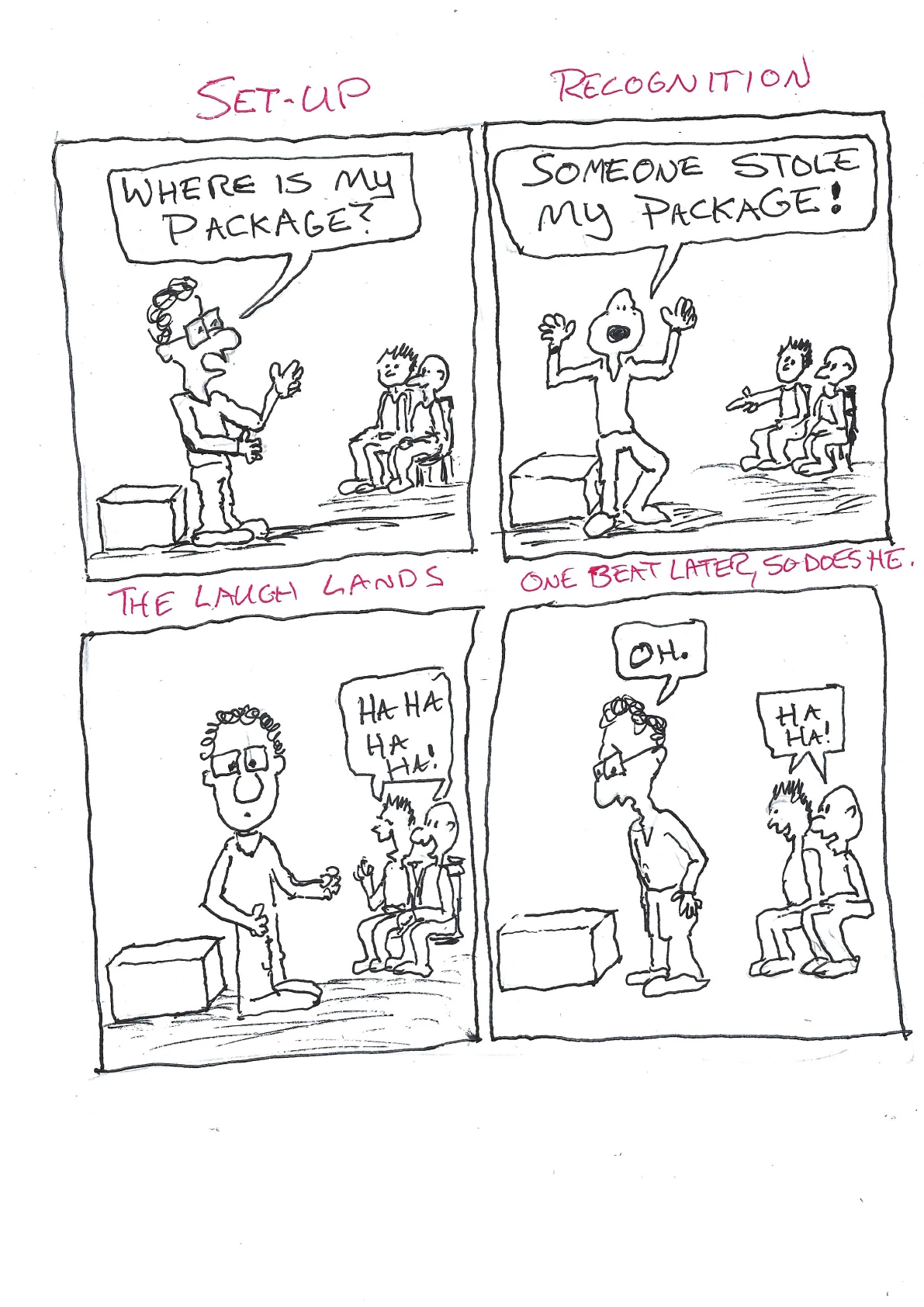
Two laughs. One joke. The first is anticipation: the audience recognizes the machine starting. The second is confirmation: the promised tab arrives. Between them comes the reach, the turning pages, and the pause before Holly reads. That interval belongs to the performance, but the audience fills it. They know what is coming and enjoy knowing.
I used to think this was the opposite of a surprise. A conventional punch line points the audience one way and lands somewhere else. The binder tells them exactly where it is going and takes its time getting there. But both forms depend on prediction. One overturns the audience’s expectation. The other keeps it. A telegraph is not automatically a failure. In comedy, it can be a promise.
The promise still has to be timed. Rush the pages and the two laughs collapse into one. Stretch them and anticipation becomes impatience. The audience stops feeling clever and starts feeling managed. The delay has to last long enough for recognition and not a beat longer.
I was reminded of that recently while performing in Popguy the Sailor Man. My character steals Popguy’s spinach, and when Gimpy confronts her, she says, “Well, nobody expected the Spinach Inquisition.” One night the joke died because the next line arrived immediately. The audience needed a second to catch the reference, and the script had not protected that second. I had written the line but not the delay that made the line playable. If the beat is load-bearing, it belongs on the page.
Dinner theatre taught me another use for that interval. A room full of tables does not hear at one speed. Some people catch the machine immediately. Others are mid-bite, mid-anecdote, or listening around a server. The first laugh gives the rest of the room notice that something is happening. By the time Holly reads the tab, the slower tables have caught up, and the second laugh can land across the room. The delay does not merely hold the joke. It synchronizes the audience.
The fullest comic machine I have built belongs to Ah-Choo, a sous chef in Café Rescue, which I wrote with Dustin Heavilin. The first time someone says his name, Ricky answers, “God bless you,” and the gag explains itself as it fires. By the third repetition, the audience laughs when the name begins, before the blessing arrives. The laugh has moved into the delay.
The responses vary—“Gesundheit,” “Salud,” several people shouting at once—until Ricky begins the blessing, catches himself, and says, “Nope. I’m not doing it.” The audience supplies the missing response and laughs at the one the actor declined to give. A repeated joke has become an agreement. The machine can now run without completing its own motion.
Once the audience has learned that agreement, the same mechanism can conceal information. All evening, Ah-Choo announces that somebody has stolen his ladle, his whisk, or his mise, and each object turns up in his apron, under his seat, or inside his hat. “Someone took it” becomes a comic reflex the audience has been trained to dismiss. When someone actually tampers with a dish—in view of anyone watching closely—the running gag provides cover. The telegraph becomes the misdirection. The audience laughs at the habit that hides the clue.
Betsy’s mentors extend the delay even further. Each time she begins, “My Uncle Ben always said,” or credits her training to Orville Redenbacher, the room recognizes the construction and starts laughing before the brand mascot arrives. Only in the final act does the audience learn that this imaginary family is the motive. They have been laughing at a confession without knowing it was one.
The distance between anticipation and completion may be half a second, a slow reach across a binder, or two acts. The scale changes, but the work is the same. The joke teaches the audience how to read it, then gives them time to participate in what comes next.
That is where the laugh lives: not simply in the line or the surprise, but in the charged interval when the room knows the promise and waits to discover how it will be kept.